Covid 19 – Green Update

After much discussion by the bowls committee and the board, the decision to open the green has been made and will happen on Saturday 20th June 2020. With this in mind there are guidelines that will need to be followed and are outlined below. If you intend on using the facility please ensure you have read what is required from our members to enable us to open the green during this time. A copy of the guidelines and the BCGBA risk assessment will be displayed at the club for all to read. Take care and stay safe.

Covid 19 Green Opening Guidelines MBC

  • Members only will be permitted to play on the green
  • If you haven’t yet paid your subs please contact Peter Tomlinson – 07984419110 to arrange to do so prior to booking on to play
  • All players are required to sign in and out of their booked time slot – the book will be located under the tea hut. This is to assist with the track & trace system we have to have in place in order to open the green. Any issues with signing in / out please contact the club secretary Andrea Ainley – 07557332168
  • All players must book a time slot with the club secretary (text or phone call) – No booked time slot = no play Contact – Andrea Ainley – 07557332168
  • Slots must be booked with 24hr notice
  • No block bookings will be taken
  • If you are unable to attend your booking you should notify the club secretary Andrea Ainley – 07557332168 at the earliest opportunity
  • There is no use of club facilities available currently including toilets
  • Members should where possible not use hand rails / benches / seating etc to reduce the risk of infection
  • Maximum of 6 people allowed on the green at any time
  • If you intend on playing with another person(s) – the person(s) must be named when booking on and should not change unless the secretary is notified prior to your time slot
  • Players are unable to use club blocks – you must use your own equipment
  • Players are encouraged to wash equipment prior to and at the completion of play
  • Wash your hands as often as possible and use sanitiser where and as often as you can
  • Any person suffering symptoms of Covid 19 must notify the club secretary at the earliest opportunity

Booking Slots available Monday – Sunday as follows:

  • 10am – 11:15am
  • 11:30am – 12:45pm
  • 1pm – 2:15pm
  • 2:30pm – 3:45pm
  • 4pm – 5:15pm
  • 5:30pm – 6:45pm
  • 7pm – 8:15pm

Any persons found to be acting outside of the above guidelines will be brought before the committee.

A History of the Meersbrook Bowling Club Limited: The first ten years (Part 2)

I hope you’ve enjoyed part one and want to continue the journey back to Victorian MBC and the happenings in Meersbrook on Shirebrook Road. Get your corsets, bustles, top hats and morning suits ready!

Ian. C

From little acorns…

Over the next 10 years 130 new members were admitted to the club as the membership steadily grew. Many of these new members were local industrialists, amongst these were cutlery, file and saw manufacturers and some were probably what were known in Sheffield as ‘Little Mesters’ and these industries although some long gone, are synonymous with the historical industrial legacy of Sheffield. It may be of local interest for our members and people who are familiar with the Bowling Club to note the addresses and residences of the committee members we have met so far, who lived in the surrounding area of MBC. Of further interest to members and people who live in and around the Meersbrook area of today would be to note some of the names and addresses of some of the members who joined during the 1870’s and 1880’s and to potentially see what the residents of their current addresses were up to back in those Victorian times. Let us meet a few of them now:

John James Barton, a saw maker of 3 Alexander Rd

John Batt, a manufacturer of silver-plated spoons, forks, desserts and fish carvers of 8 Albert Rd.

Thomas Radley Cadman, razor maker of 6 Sheaf Gardens

Charles Cleg, saw and file maker, of Myrtle Rd

James Gallimore, a silversmith of 15 Albert road

Frederick Hemingway, file cutter, of 30 Sheaf Gardens Terrace

William Henry, a maker of pen and pocket blades, of Solly St

Richard Jervis, an Iron founder and Cutler, of Glen View, Victoria Rd (Shirebrook Rd).

Joseph Kay, table knife hafter, 64 Wellington St

Samuel Marshall, manufacturer of sheep shears, scythes and machine knives, of 218 Victoria St

This is an example of the many interesting people living in and around the Meersbrook area at that time and gives us a glimpse of what they were up to in their working lives as well as their leisure time.

Amongst the eclectic fledgling membership of MBC were professional men including: a dentist, two doctors, an artist, and a professor of music. There was a Farmer residing at nearby Lees Hall at Norton, a Pawnbroker from London Rd and a Cattle Dealer from Ecclesall Rd. There were also the Landlords of the nearby Wagon & Horses and White Lion Public Houses, who possibly used their membership of MBC to enable them to have a drink and leisure time somewhere different from their own licensed premises, but not too far away in case they were called upon to deal with any shenanigans! Many of the growing membership gave their occupations as Manager or Clerk, and there were several cabinet case makers, presumably making cases for cutlery or blades. We can easily imagine that these cases went on to contain the cutlery made by some of the members named previously.

A Grand Opening for two shillings and sixpence!

The social life of the new club was inaugurated with an opening dinner for which the steward, Mr Boler, was instructed to provide a bill of fare for two shillings and sixpence. Dinner was to be on the table at 7:00pm prompt. The members were to be offered:

Salmon with parsley butter

Roast beef and lamb

Boiled leg of mutton with a caper sauce

Boiled tongue and ham

Peas and potatoes

Cheese and salad

Cherries and strawberries

The secretary was then instructed to issue circulars and dinner tickets to all members, those not wishing to use them with to return them by the 9th of July, otherwise they would be charged for the tickets. These instructions must have caused a little friction or perhaps some confusion. Although there were to be many more dinner functions in the years to follow, this method of issuing tickets was quietly dropped.

The next social function was held to commemorate the visit of the Prince and Princess of Wales to Sheffield on the 19th of August 1875. It was resolved at a special committee meeting on the 6th of August to provide tea and entertainment to members and their families and lady visitors. This is the first mention of members families, but by no means the last, the club soon began an ambitious programme of entertainments: Dinners, teas, dances, balls, concerts, lectures and children’s parties.

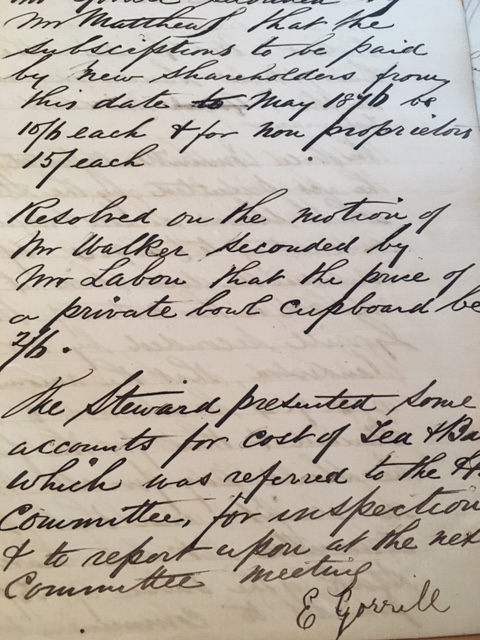
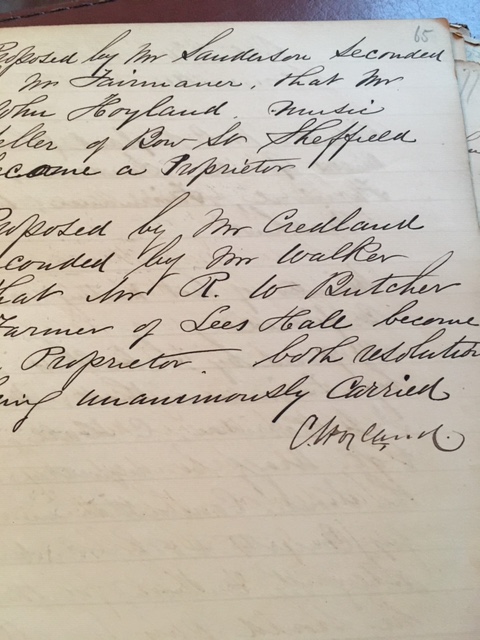
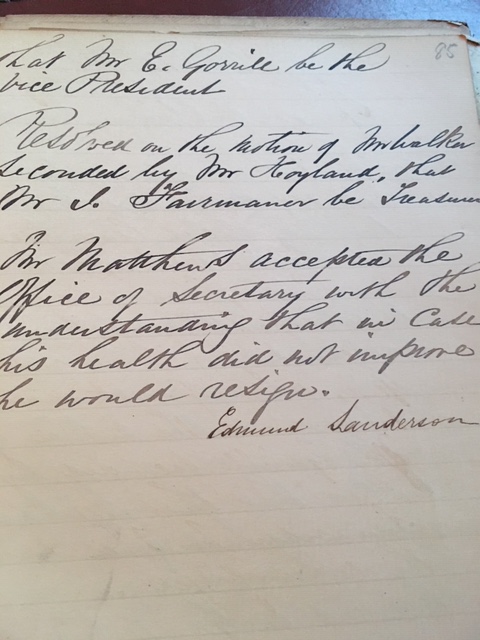
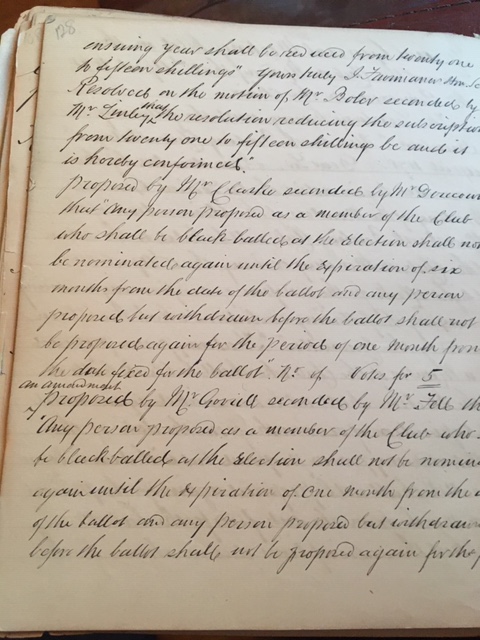
Around this time period of late summer 1875 in the minutes in becomes apparent that the first Secretary and Architect of the Bowling Club, Mr Matthews becomes ill, although what form this illness takes is not known. We start to see footnote comments on the meeting minutes such as “Sect’y at home ill” What can be seen because of this is the differing handwriting styles and different signatures meeting to meeting, as seen below:

Firstly Messrs Gorrill, Hoyland & Sanderson. Lastly the wonderfully neat writing of the Clerk to the County Court, Mr Jabez Fairmaner!

IMG_0374IMG_0375

IMG_0376IMG_0377

Mr Matthews illness continues into the following year and in the minutes from the second AGM on 15th May 1876 we can take it Mr Matthews was at least present as the records state:

“Mr Matthews accepts the Office of Secretary with the understanding that in case his health did not improve he would resign.”

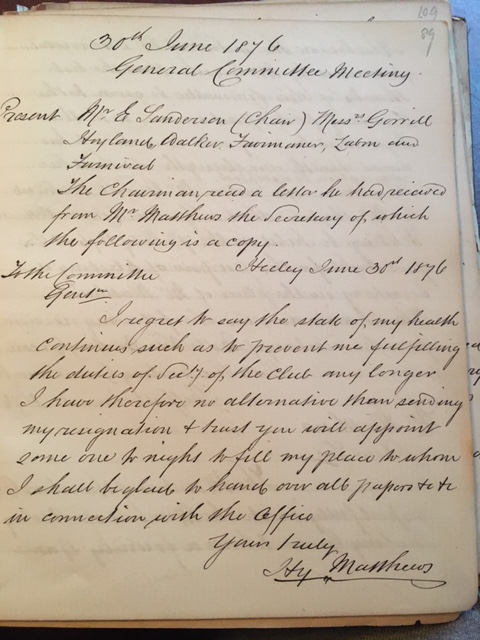
It seems Mr Matthews health did not improve, and he did indeed resign shortly after on the 30th of June. His fellow committee members recorded there thanks and best wishes, and we can see a copy of his resignation letter below. There, sadly early in the story of MBC we say good bye to him. However, we say thank you Henry Matthews! Without your architectural plans we wouldn’t have today the iconic building we all know so well.

IMG_0379

On to happier events! The social calendar at the club began each year with a dinner, marking the closing of the green and ended with another dinner, marking the opening of the green. Between these events there was a dance at least every fortnight, either a “soiree dansante” or a “quadrille assembly”, as well as concerts and readings. The high point of the social year was the annual dinner and ball. There was usually a charge for attendance at these functions: one shilling for the dances, but for the ball the charge was much greater. A member’s single ticket cost 6 shillings, a double ticket 10 shillings and sixpence, a “strangers” double ticket 12 shillings and sixpence the cost of engaging 5 musicians for the evening was £5, 17 shillings and sixpence.

Another regular social occasion was the “juvenile party” held in January each year. The steward was empowered to buy apples, oranges, figs, bon bons and gingerbread. For these children’s parties in the early years of the club’s existence a charge of sixpence a head was made and toys were distributed to the children, but this was soon dropped. No reason was given in the minutes, but it is easy to imagine what kind of problems would be involved. After this there was no charge for the party. A “Magic Lantern” was provided at the party in 1881 , and in 1883 the committee awarded the steward and stewardess 20 shillings for “the extra trouble in having made all the eatables for the children’s party”. This is the last mention of the “juvenile party” in the existing minutes books , there were no children’s parties in 1884 and 1885.

In the September of 1877 the committee resolved to purchase a piano “for entertainments” at a cost the £42, a £12.00 down payment with the remainder to be “paid as may be arranged” with interest at 5% on the balance. We can only imagine that the music provided for the fortnightly dances and many concerts before the piano was acquired were at the same £5.17.6d cost for the musicians, so perhaps a piano was brought in for the purpose of saving cost. Perhaps the shrewd Mr Sanderson had his hand in this deal too!

We know that in those days they thought nothing of moving pianos from venue to venue. Shortly after the club bought the piano, the Heeley Cricket Club of Meersbrook Lodge borrowed the piano for a concert in Thirlwell Road School and they guaranteed to “remove and return it without damage”.

The MBC ‘Sporting Life’

Although the club was founded as a Bowling Club there is very little mention of the game in any of the minute books. We know that the opening and closing of the bowling season were celebrated with a club dinner and most years the club also held a bowling tournament for which the committee or the club President provided the prize, usually a set of bowls. In 1881 the tournament was not played due to lack of interest, and the prize money was set aside for the purpose of running a billiards tournament instead! In the minutes there is only one mention of a game with a visiting team, a friendly with the Belle Vue Bowling Green, on Queens Road, which was held on the 26th of July 1876. Mr W.E Gillott, Secretary of Belle Vue wrote to:

“Respectfully invite the members of the ‘Heeley Bowling Green’ to have a friendly game” on “any Wednesday afternoon that will be most convenient to you”.

Mr Fairmaner wrote back to Mr Gillott on behalf of the club to accept this proposal and stated this friendly should take place on “Wednesday the 26th July at 4 o’clock” and requested “should the day and time appointed be inconvenient an early intimation will oblige.” Apparently “nine or twelve members propose attending.” Now this date was indeed inconvenient to the Belle Vue bowlers who seemed to be a well travelled lot! Mr Gillott wrote back to say:

“The date you have kindly named to pay us a visit has happened rather awkward as we play a game at Manchester on the Saturday & many of our members are going away, and so if you will postpone the visit a week or two it will suit our members better and hope it will not inconvenience yours, and I think the game can be arranged more satisfactory.”

There is no further mention of the game, so we have no way of knowing if it went ahead or any results. We can wonder if members of the ‘Heeley Green’ felt their noses were put out of joint! Maybe if it did take place, the match was not so friendly after all!

We can deduct from the previous reallocation of bowls tournament prize money; that the popularity of billiards wasn’t in doubt. The minutes confirm this assumption as they are full of references to billiards tournaments, prize monies, entrance fees, and handicapping committees. The bylaws of billiards and the tariff were printed and hung in the saloon in 1876 and the following notice had cause to be hung in the saloon in February 1879:

“On Saturday night each game of 50 at billiards shall not occupy more than 30 minutes and each game of 75 (four players) not more than 45 minutes and the member who was scored the smallest number shall pay for the game”.

During the 10 years covered by the first minute books, two new sets of billiard balls were purchased, the cushions were repaired, the lamp shades renewed and both tablecloths were recovered. One unfortunate member, Mr Thornhill (Shock horror! Not even a full member but a lowly nominee member!) tore the cloth on one of the tables! The committee had the cloth replaced at a cost of £6 10 shillings and asked Mr Thornhill to contribute 30 shillings towards the cost. Mr Thornhill apparently refused and the affair rumbled on through the minutes until eight months later the Secretary, Mr Fairmainer, reported that Mr Thornhill had not replied to his letters demanding 30 shillings, and it was resolved that the Secretary write again giving him 7 days’ notice, and then to take the matter to the County court!

We can only assume that faced with this ultimatum Mr Thornhill paid his dues and demands as there is no mention of the matter again! Maybe this had something to do with Mr Fairmaner working in said establishment!

Along with billiards, members were also fond of a game of cards. During most winter seasons there were regular whist tournaments, and the whist tables, still in use in the games room to this day, were recovered in September 1879. The committee had purchased three dozen packs of cards in the previous month and from time to time the committee announced charges for playing cards. For example, on the 30th of November 1877 it would cost you a half penny for a game of cribbage. On the 28th of January 1881, “1 penny per half hour” was charged for any game of cards. There is an interesting entry in the minutes for the 25th of November 1876 at which the committee resolved that members should not be allowed to play at the game of Napoleon! Although not popular now this game was certainly popular in the in the 1800’s. The old game of Napoleon consists simply of five cards dealt singly with the various players bidding in their turn how many tricks they think they can make, Napoleon is a straight forward trick taking game in which players receive 5 cards each. Needless to say, but it doesn’t seem particularly controversial enough to be banned, however it is usually played for stakes with an equal number of chips or money distributed to every player, one variant was known as ‘penny nap’ where each trick was worth 1 penny. Maybe the committee were worried this game promoted illicit gambling habits!

As many people know Angling has also certainly played a part of the clubs’ history over the years and we have some very keen and talented anglers amongst the membership currently. There was some early days interest in this sport too. There was a resolution passed in the minutes from January 1879 that permission be given to form an angling club though for some unexplained reason this section didn’t come to fruition at that time. Maybe in future minute books we can find out when it made its resurgence.

See you in part three!

A History of the Meersbrook Bowling Club Limited: The first ten years (Part 1)

I know history isn’t everybody’s thing, but when we consider that we nearly lost MBC forever, and also remember some of the huge characters in bowls we’ve lost in just this last year or so, I ask one thing. Where would we be without bowls clubs and bowls characters? Our clubs and pavilions are covered in photos of wonderful bowlers and characters that are a part of all our history, and as we reflect during these strange and troubled times in 2020, long may they all be remembered.

Several years ago, in a carrier bag, under a bench seat in the TV room and covered in dust, we found the first 2 minute books of Meersbrook Bowling Club. These minutes cover the years 1874 to 1884 and these wonderful documents are now very fragile, but written quite beautifully in ink pen and it is a honour that they were entrusted to me for temporary safekeeping. A previous past Director had summarised some of the content in a document but we don’t possess a copy of this electronically. So during this strange period of time in as we reel from the covid-19 pandemic, I have taken the opportunity to study these historical documents  and revise the first ten years history of MBC. As you can imagine, the world was quite different in those days, but also strangely similar in some cases! I hope you enjoy this little journey back to Victorian Sheffield and Meersbrook as much as I have, and meet some new ‘old’ characters along the way.

Ian Christopherson

Beginnings: October 1874

In 1874 Queen Victoria was in the thirty seventh year of her reign as Monarch. It was a general election year, with William Gladstone’s Liberals losing out to Benjamin Disraeli and the Conservatives.

On Wednesday 7th October, the Sheffield & Rotherham Independent reported that election riots in the town of Northampton had resulted in the Army being called into action as the Riot Act was read. Meanwhile in Sheffield, a local Butcher from St. Phillips Road was arrested on charges of sheep rustling from a field in Crookes.

The Sheffield Daily Telegraph had reports of the new Licensing Act, this meant ‘country’ pubs had to close by 10pm while ‘town’ pubs were allowed an extra hour’s grace closing at 11pm. Earlier that day at Ecclesall, the Funeral of Mr. George Brown took place. George Brown was the Nephew of the famous John Brown, who had steelworks in Sheffield and shipyards on the Clyde in Glasgow. George Brown founded the Brown, Bayley & Dixon works on Leeds Road near where the Olympic Legacy Park is now situated. Local press also reported occurrences of ‘rattening,’ a form of industrial sabotage where a Razor Grinder had his wheel and drive belt stolen and a Saw Grinder had his wheel damaged.

Later that evening in the Sheaf Street Schoolrooms a meeting was held at which Meersbrook Bowling Club was founded. The location of these School Rooms is not exactly known, this Sheaf Street itself extended from Ann’s Road to London Road and it is now part of Gleadless Road. At the meeting, Mr. Alfred Sellars had the chair. Little is known about him apart from the fact he resided at Victoria Villa, Victoria Road. Victoria Road changed its name at some time between 1874 and 1884 to Shirebrook Road. What we can say that he must have been a man of means to have resided in a large house in a salubrious part of the City. And there, just as quick as he joins the story, the mysterious Mr. Sellars leaves it. Despite the fact he lived on the club’s doorstep he never joined the membership, did not become a shareholder, and is never mentioned in any surviving meeting minutes again!

Alfred Sellars from the chair introduced a new speaker, Mr. Edward Gorill who lived at Brighton Villa on Victoria Road. Mr. Gorill was a scissor manufacturer of Robert Gorill & Sons and went on to inform the meeting of the steps already taken to form a ‘Bowling Green Club’ in Heeley.

Minutes from the first meeting

The next speaker was Mr. Henry Matthews, an Architect and Surveyor, also residing on Victoria Road at Melrose Villa. Mr. Matthews explained plans for the necessary buildings, giving estimations of ‘probable receipts and disbursements’ of the club.

The meeting then agreed ‘that a proprietary club be formed’ with shares being issued at a value of ‘£5 each should be issued, the number to be limited to 150 shares’. Share were to be paid for in the following way: ‘ten shillings down, ten shillings on the 1st December next, and £1 on the first day of January, February, March and April 1875. The title for the new club was decided as ‘The Meersbrook Proprietary Bowling Green’ though this was changed in a very short time to ‘Meersbrook Bowling Green Club’ It appeared that this was the title up to 1884 when the club was incorporated as a limited company, remaining to this day as ‘Meersbrook Bowling Club Limited.’

It was resolved at that first meeting that an Annual General Meeting would be held in May of each year, and that the following gentlemen would form a committee:

Mr Edward Gorill and Mr Edward Matthews, whom we have already met.

Mr Edmund H Sanderson an accountant of E. Sanderson and Son. Mr Sanderson’s home address was Arundel Villas, Victoria Rd and his neighbour in Arundel Villas was the American consul in Sheffield, Dr. Claudius Buchanan Webster.

Mr Charles Hoyland, brush maker whose factory was at 97 to 99 Queen St and his home was Kent House, 98 Kent Rd now numbered 106.

Mr Thomas Vernon, a Cork manufacturer with premises at 2 Union St, home address 119 Kent Rd now 275 Albert Rd.

Mr Samuel Walker of Lambert St.

Mr Thomas Credland, a timber merchant and marble chimneypiece manufacturer of Heeley Bridge works, 376 London Rd.

The remaining two members of the of the original committee were a Mr Barrows and Mr JD Harrison about whom nothing is known, except that Mr Barrows took a trip to Derby to inspect some buildings made of a special type of white brick in which the club was interested.

There we meet the founding fathers of the Meersbrook Bowling Club, they were all successful men, businessmen and professionals. Victorian gentleman who saw the club as a desirable asset to their neighbourhood. These men laid the foundations of the club with such care for its security that it is still in existence and flourishing today.

The Foundations are Laid

Two days later the 9th of October 1874, a further meeting was held the Red Lion Inn on London Road, this was the first committee meeting. All the committee were present except Thomas Vernon and JD Harrison who ended up both resigning from the committee before the end of the year. Mr Hoyland was voted President, Mr Gorill Vice-President, Mr Sanderson became Treasurer and Mr Matthews became Secretary, all these men lived close to the site of the club.

At this meeting, the committee bought the land on which the club was to be built. It was a plot belonging to the accountant Edmund H Sanderson. Mr Sanderson stated that he could not take less than five shillings per superficial yard, but in consideration of the plot being large and the object of this venture a very desirable one, he would supply all the cash required for carrying out the works and also allow the purchase money of the land to remain unpaid until the 1st of May 1875 without charge. After this time, the remaining unpaid money should bear interest at the rate of 5% per annum. A very shrewd man seems Mr Sanderson! The club’s Solicitors Messrs Smith and Hind prepared an agreement and the deed was done! Agreement was reached that workman be employed to start levelling the ground immediately.

The further meeting at the Red Lion was held on the 17th of October, 10 days after the original meeting in the School Rooms it was reported that the work of levelling was progressing satisfactorily. Trustees were appointed to their positions and Henry Matthews was made architect and surveyor of the club property. Legend has it that Mr Matthews was an Architect for the Railways and that is why the club building resembles a Railway Station, but no evidence has been found in the minutes to confirm this. It is a good story regardless, and if you look carefully enough you can still see ‘the platform’ underneath the present-day Conservatory.

It was decided to open an account with the London and Yorkshire Banking Co. Ltd, Sheffield. All accounts of £2.00 and upwards “shall be paid by cheque, signed by President, Vice President, Secretary and one committee member”. The Treasurer was empowered to pay “all datal wages upon receipt of the Architect’s certificate” and the Secretary was “empowered to provide all requisite books and stationery”. The committee decided to meet every Friday night at 8:30 prompt, latecomers were to be fined, anyone not in attendance at 8:35 were to be fined 3 pence, and if anyone so dared to be as late as nine o’clock, they were to be fined a hefty sixpence!

Election to the club was to be decided by ballot among the committee: “2 black balls shall exclude”, this was a practice that was carried out at the club for many years with potential members running the gauntlet to avoid being blackballed! At this meeting we meet the club’s very first two members who were admitted by the newly formed committee. They were Joseph John Earnshaw a Coal Agent for the Dronfield Silkstone Coal Company at Heeley station and he lived on Well Rd. The other newly admitted member was John Figorski, a cabinet case manufacturer with premises on Watson Walk and he lived at 95 William St.

Another piece of business transacted at this meeting is of interest to the many Snooker Players who have played the tables at the Bowling Club, and this decision was very important to the future of the club. It was decided to make alterations to the architects plans to allow for two tables in the billiard room and Edmund Sanderson’s hand can be seen again in this decision, as he was so determined to have two billiard tables in the premises he later bought one of the tables from out of his own pocket. We can imagine that the shrewd Mr Sanderson had probably calculated that the 5% interest accrued on the building loan would cover his expenditure!

In the busy month of October 1874 there were two further meetings on the 23rd and 30th of October. During this time period the site was being levelled and the retaining walls were being built. During November, the committee spent time discussing the use of white bricks in the construction of the clubhouse. A friend of Mr Sanderson who lived in Northampton, reported on the advantages and disadvantages of white bricks. “They have to be neatly laid by a skilled Craftsman otherwise they soil with handling; they should be well protected by a cornice and no water spout should be likely to flow on them; but they are very striking in appearance, especially if laid in panels along with red bricks”. Mr Barrows had inspected some buildings incorporating white bricks in Derby and he espoused that he was very satisfied with them. The committee resolved to face the club with the white bricks purchased from Tera Cotta Company, Coalville and dressed in red bricks from the same source, and the striking results can be seen to this day.

At a meeting in the Red Lion on the 4th of December 1874 the committee adopted the architect specifications and resolved to advertise for tenders for building the clubhouse. Advertisements were made, four times in the Telegraph and the Independent and once in the Post. There were 19 tenders for the work but only one, from Foxton Brothers, for the whole work whose tender was £1051.00. Most tenders received were for a part of the work, there were tenders for joiners’ work ranging from £295 and 15 shillings to £335. The roof slaters tenders ranged from £67 to £71, plasterers from £57 to £67, plumbers £95 to £120 and painters from £22 to £26.

The total cost of the building came to £886.5.0 and the successful tenders received were from:

James Wilkinson, for bricklayers’, masons’ and joiners’ work: £650

Staniforth and Lee, for roof slating: £68

C Unwin & Son, for plastering: £49.15.0

JT Taylor, for plumbing: £95

GE Bennett, for painting: £23.10.0

For the following three months there were no more meetings, presumably to give time for the club construction to progress. On 27th of March 1875 the committee met for the last time in the Red Lion and discussed advertising for a steward and stewardess and to get tenders for the laying of the Bowling Green. Again, advertisements were placed in the Sheffield Telegraph, the Independent and the Post. All meetings from this time forward were held in the new clubhouse. The topic of discussion with the 13 applications for posts of steward and stewardess and these were mostly from the Sheffield area. Applications were all also received from Doncaster and one from Bridlington Quay. All applicants had been has asked to say what salary they would expect, and expectations ranged from 18 shillings a week from George Andrews of Walkley, to 70 or 80 pounds per year. One applicant, C Barker of the Saint George’s club, “could not say” what he wanted! A shortlist of four was drawn up and the company secretary was instructed to write for references. At a following meeting on the 16th of April, it was decided to appoint Charles Boler and his Wife of Franklin St, and they were to be paid a weekly salary of “20 shillings plus all profits arising from the sale of unexcisable articles to members”.

The advertisements to tender for laying the Bowling Green brought three replies. One from James Bower offered to do the job for £34 & 16 shillings, William Markham would charge tuppence halfpenny per yard for spreading soil and fourpence halfpenny per yard for turf.  A Mr Pepper quoted seven pence & three farthings per yard for the whole work. The secretary and some of the committee members met with William Markham, and on the 23rd of April he was given the work.

Edmund Sanderson we have previously learned, persuaded the committee to amend architectural plans to make room for two billiards tables and at the first meeting in the new clubhouse on the 9th of April 1875 he offered to pay for one of the tables so it is fair to say that Mr Sanderson was obviously a keen billiards player. The committee agreed to buy two ‘Specialite’ tables from Burroughs & Watts of Manchester and these had a cost of 72 Guineas each with fixing being three Guineas extra.

With the spring of 1875 a renewed period of activity began. Between the 9th of April to the end of May the committee met no less than eleven times, appointing Steward and Stewardess, having the green laid, installing the billiard tables, preparing the rules of the club and furnishing the club saloon. The floor of the saloon was covered with ‘Suberium’, a floor covering made from Cork at a cost of four shillings per yard, accept under the billiard tables where an oil cloth was used. The floor of the boardroom, which is now the TV room, was covered with drugget, a coarse woven and felted woollen fabric along with a hearth rug. Fenders and pokers were supplied for the saloon fires along with a set of fire irons for the boardroom, green Venetian blinds were fitted to the windows of the saloon and the billiard room. The saloon was furnished with Seven tables, a dozen armchairs and three dozen small chairs. Arrangements were also made to erect a flagpole on the premises, and this can be seen in several of the watercolour paintings we have of the club. Although no longer feature of the club the flagpole did remain a feature up until the early 1980s.

Administration and Management: The first Annual General Meeting.

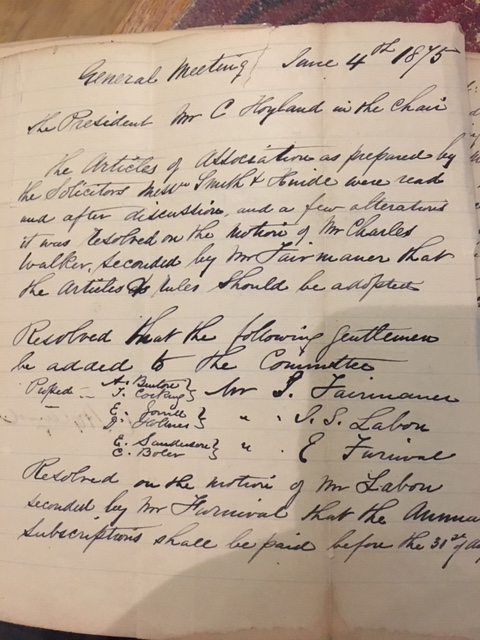
On the 4th of June 1875 the first Annual General Meeting was held. The president, Mr Charles Hoyland took the chair. At this time 36 men had joined the membership of the club, but two Messrs Harrison and Vernon had resigned. The ‘Articles of Association’ were read and discussed, and alterations were made before they were fully adopted. Unfortunately, we do not have a copy of the original articles, but it would be interesting to see a copy. Under their rules a member who resigned his membership was able to keep his share but we are unsure as to what value it had at that time, nowhere in the minutes of the first ten years is there any indication that the club ever paid a dividend to shareholders. Some current shareholders may comment that nothing has changed up to the present day! It is fair to say however that there have been several share issues since the original shares were issued in 1874, but it would be of historical interest to see one of these original share certificates as a part of the clubs history. At a committee meeting in May 1876 the secretary read a letter from a Mr Leonard A Ryalls of North Church Street who had bought a £5 share. He did not want to pay the 21 shillings per annum subscription, and he had no intention of using the Bowling Green, however he made it clear he did expect to receive any dividends owing!  The committee resolved to accept the suggestion but again there is no mention of any dividends in the minutes perhaps its only value was that of entitling the shareholder to a share of the proceeds in case the club was wound up.

At that very first AGM it was also resolved that subscriptions be paid before the 31st of August and three names were added to the committee, and they were interesting names to say the least:

The exotically named, Mr Jabez Fairmaner of 181 Cemetery Rd, who was chief clerk of the County court.

The intriguingly named, Mr Joseph Sales Labon, a Manager, of 21 Gleadless Rd.

And finally, the ordinarily named, Mr Edward Furnival, of Furnival & Ibbotson, who lived at 25 Broadfield Rd.

Minutes of the first AGM
IMG_0353

It would be fair to say that in those early days the organisational structure was fluid and an example of this can be seen in a motion from the committee meeting on the 16th of June in which the committee divided itself into three subcommittees. These being: Finance, House and Green. The duties of each were set out at later meetings but in summary; the Finance committee would arrange payment of all accounts in due course and do everything pertaining to cash transactions of the club. The House committee would bottle all spirits etc required by the Steward, order ale, spirits, beers, cigars and generally superintend internal management of the club. The green committee would superintend the management of the grounds and give instructions to the steward as to the rolling, mowing, seeding of the bowling green, and every other matter connected with the external business of the club within the boundary walls.

It is interesting as a current Director of MBC, to note the similarity between the original 1870’s setup and how the current organisation is structured since we became self-managed back in December 2017. Though, in a sign of current times, there are a lot less bodies doing the doing now!

The House committee’s duty filling bottles with spirits throws an interesting light on the bar practice in the club in those early days. In an earlier meeting Edmund Sanderson and Edward Gorrill had been appointed to visit Beatson & Company’s glass works in Rotherham where they were instructed to inquire about “small decanters or spirit bottles”. They reported their findings back to the meeting of the 29th of May and the secretary was instructed to order 3 gross of small decanters at 25 shillings per gross, subject to 5% discount for cash. It would be interesting to know if these are the small bottles listed in the early bar tariff on the following page, and it would also be interesting to know how much liquid was contained in those small bottles. We know that the club bought Irish whiskey by the quarter cask, shipped from Cork in Ireland for 15 shillings per gallon or roughly 1 penny per ounce. If the small bottle held three 3 ounces and sold for fourpence the profit would be a little more than 15%. Would that be a margin likely to satisfy the operations of a small private club in the 1870s?

How much does it cost to get a drink in this place?

The scale of charges and bar tariff was fixed at two meetings in June, they were as follows:

Brandy, Rum, Scotch whisky, Irish whiskey: 4d per small bottle

Gin: 3d per small bottle

Bottled beer: 3d per bottle

Draft beer: 2d per glass

Sherry & Port: two shillings and sixpence per pint, three shillings and ninepence per bottle

Hock: one shilling and sixpence per pint bottle

Claret: one shilling and threepence per pint bottle

Lemonade: 2d

Schweppes lemonade: 4d

Soda water: 3d

Schweppes soda water: 4d

Cup of tea: 2d

Tea with bread and butter or toast: 6d

Chops with plain bread: 8d

Steak (rump) with plain bread: 10d

Welsh rarebit: 4d

This all sounds remarkably civilised, And I must admit I can’t really imagine in this day and age coming off the green after a hard fought battle against Bradfield or Meersbrook Park in the Meersbrook Derby and exclaiming to whoever is serving at the bar:

“My good man / lady! One of your finest Rumps steaks with plain bread if you please, medium rare, and a Welsh Rarebit for my worthy opponent!”

Part 2 to follow soon. IC.
Sheffield & District Parks Bowling Association May 2020 Newsletter

As we are unable to hold a meeting this month I have tried to write
a news letter to share whatever information we have.
Both Terry and Gary have added to it and I will post a copy to David
who I believe is making good progress now and I am sure we
continue to wish him well.
Obituaries
As is customary at our meetings we will start by remembering the
bowlers who we have lost.
Ken Wild of Nether Edge, Barry Clinton of Thorncliffe and Jim
Holloway of Ecclesfield
all passed away before our March meeting.
Roger Garbutt – who was 82 years of age passed away at the
beginning of May Everyone will remember Roger as competitions
secretary for the Association a role he filled with enthusiasm and
hard work for many years. As a metallurgist Roger worked in
Redcar, Rotherham, Tinsley Park and Stocksbridge. When he
retired he joined Stocksbridge Bowling Club and became a stalwart
member of their committee. Later in life he decided to join a club
nearer his home in Whiston and that was when he joined Catcliffe
where again he was a hands on member.
His funeral is at Rotherham Crematorium on Tuesday 19 th May.
Mourners at the funeral are restricted to immediate family and two
bowling friends who have been invited
The family feel it would be nice to have flowers to make up for so
few people being allowed to attend. They are also hoping to
arrange an Ashes Scattering Ceremony at a later date when
charitable donations may be made.
Flowers can be sent through “Forget Me Not Florists” at Rotherham
Phone 01709 829204
Keith McSloy – aged 71 Keith was secretary of Sheffield & District
Social Clubs Bowling Association for many years running their leagues and competitions. He started bowling in 2001 when ha
retired from the police force and continues to play at Niagara for
Intake, when that club folded he played in the Vets team at Colley.
He became involved with S&DSCBA when he started helping Mrs
Knowles who used to run that Association. He was a formidable
opponent on the green.
His funeral will be held at Grenoside on Thursday 28 th May at 3.30,
Frank Ellis has been invited to represent bowling. The cortege will
be leaving his home on Wellbeck Rd Walkley at approximately
2.45pm If anyone wishes to stand at the kerbside as a mark of
respect.
Trevor Brown a long time member of Longley Park BC playing in
their Vets A Team until the end of last season. Trevor was taken ill
on holiday before Christmas and died on the 10th March.
Harry Gillott of Firth Park died on 31 st March aged 88. He had not
played for several seasons due to ill health which he fought
valiantly. He was a lovely chap who always followed the progress of
Firth Park in the leagues.
Ruth Noble – also of Firth Park who died on 5th April aged 80. She
used to play at Abbeyfield and came to Firth Park with her friend
Maureen Barraclough. We had many good times with her and she
played until last season when she was diagnosed with leukaemia.
Albert Bedford – a life member of Middlewood Park BC Aged 93 he
had been playing until last season. A former President of the club
and a real gentleman.
Tom Shepherd – a member of Grenoside Bowling Club passed away
on May 2nd aged 89. He was still playing up to last season and was
well known on the circuit for his bowling skills, his sportsmanship
and friendliness. Many members will remember him as in his old
age he had a distinctive shuffle across the green but despite his age
he was a formidable opponent.
He was a farmer from the Worrall / Bradfield area and he will be
sadly missed for his stories, poems and singing.

Roger Dunne – a member of Bradway Bowling Club. Sadly Roger
was in hospital and succumbed to Covid 19. He was a Vets B team
player on a Wednesday and Friday.
Tina Mullins – who died on the 6th May a member of Meersbrook
Bowling Club. She was a regular member of the Wednesday
evening team and the Saturday C Team.
Michael Gaughan – a member of Crookesmoor Bowling Club. He
had been a member of their B team but had been unwell for a while.


It is so sad these bowlers have all died at a time when their bowling
friends were not allowed to attend their funerals as part of the
bowling community.
If memorial services or commemoration of life meetings are to be
held in the future I will if asked, pass on the details to members of
the Association.
As the national lock down is beginning to be lifted some bowling
greens are opening to allow play. This has to be carefully planned
and guidelines issued by BCGBA must be closely followed at all
times.
Their guidelines still state there must be no competitive play and
most County Matches and Competitions will be rolled over to next
year. The 2020 Handbook will be rolled over to next year and
addendum’s sent out as required. They will try to complete the 2019
ladies Champion of Champions later in the year.
S&DPBA Champion of Champions which should have been held on
the 8th May was cancelled but I will try and run it if possible later in
the season.
Several clubs have applied to Sport England for a grant to cover
affiliation fees groundsmen payments etc. The application has to be
done on line and before Thursday.
Please keep this years handbooks as we may be able to roll them
over to next year, but this has not definitely been decided.

The only funny story I got back from my email last week was that
Joan Ramage thinks she looks like Shirley Temple now she hasn’t
had her hair done for such a long time.
I really can’t think of any thing else to mention except that David is
beginning to feel stronger which is good news.
Gary is standing in for him at the moment and doing an excellent
job.
Terry is chasing up your monies from the council and regularly
speaking to Andy Philips in the Recreation Dept concerning the up
keep of the greens and any other matters.
Thank you and Keep Safe Jennie

BCGBA Announcement

NOTICE TO MEMBERS:

MBC are aware of the directive that has been issued by BCGBA to all secretaries regarding the re-opening of greens.
Members are advised that the bowls committee are considering the process required for our facility to re-open and will advise members once this has been finalised.
Until such a time as this is published the green at MBC will remain closed.

Stay safe everyone.

BCGBA Statement On COVID 19 Corona Virus

To County Secretaries, Management and Officers, Leagues and Members.

Following the Government announcement this afternoon it is with great sadness that we now have to suspend all bowling for the foreseeable future.

Based on the advice announced we need to avoid all mass gatherings and sporting event as these will no longer be supported by the emergency services.

If anyone within your household has symptoms then the whole family need to isolate for 14 days.

Limit social contact wherever possible and encourage working from home.

At risk groups – those over 70 and those with medical conditions need to take additional care.

All BCGBA meetings should now be postponed as un-necessary travel should be avoided. Contact in Pubs, Clubs and restaurants to be avoided.

Taking this all into account all leagues should now suspend matches until such time as we are given an all clear to resume competition.

All BCGBA and BCGLCC Competitions are now suspended until further notice this should include all qualifier events.

As a Bowls community we need to look after our members and I encourage you to follow the advice being given and support those we are able to at this very difficult time.

I will add links onto the website / face-book as these are updated.

Please take care of yourself and stay safe.

On behalf of the Management Committee BCGBA
Chris Hasselby (BCGBA Chairman)
Mark Bircumshaw (CEO)

23rd May 2020 – 9:30am Start

Approved By SYCCGBA

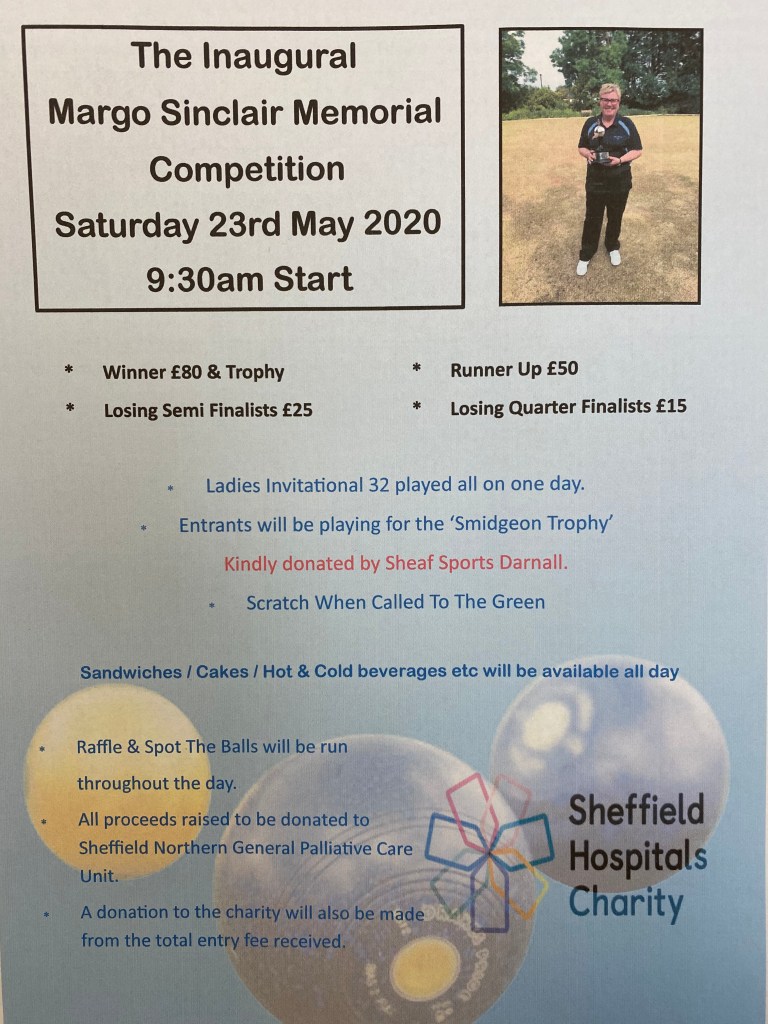
Should be a good day of bowls, all welcome to support and watch. Raffle will be run on the day with prizes donated so far from Nando’s / Sheaf Sports / Cineworld / MBC / Roneys Butchers plus many more. All proceeds raised on the day will be donated to The Sheffield Northern General Palliative Care Unit. Anyone who wishes to donate a prize for the raffle or lend a hand on the day, please contact MBC secretary Andrea Ainley on 07557332168 or by email at meersbrookbcsecretary@gmail.com.

Green Tidy Day(s)

Image result for clean up

It’s that time of year again where we start the countdown to the beginning of the league season, there are jobs a plenty that require your help to be completed!!! There are scheduled clean up / work days on the following dates: * Saturday 7th March 10:15am Start * Saturday 14th March 10:15am Start * Saturday 21st March 10:15am Start The committee have a provisional opening date however it is dependant on the work required being completed in time. So if you have an hour or so to spare please come down and lend a hand and help get the green to a position where we can open it up to the members. For more info please contact Jack Clarke on: 07963197234

Upcoming Social Events @ MBC

Saturday 11th April

Deal (002).png

Tommo’s MBC Super Deal followed by MBC high or Low card and Safecracker. 8pm Start               

               MBC Acoustic Evening                 16th March

MBC 4

MBC will host local musicians for an evening of live music. Doors open 7pm with music from 7:30pm onwards, everyone welcome.

Saturday 7th March

Image result for quiz bingo

Join us for a fun evening with Gary Hill hosting the Bingo quiz, with prizes available for Four Corners, a Line and Most correct answers, followed by card bingo. Fun and games start at 8pm.

Telegraph Cup 2020 Draw

16/04/20 – Prelims: 1) Catcliffe A v Dronfield Woodhouse 2) Richmond A v Crookes Social A

30/04/20 – Last 16 1) Winner 1 v Winner 2 2) Meersbrook Park v Crookesmoor A 3) Crookes Social B v Bradfield A 4) Ridgeway v Laycocks 5) Bradfield B v Crookesmoor B 6) Meersbrook BC B v Meersbrook BC A 7) Ecclesfield v Colley A 8) Abbey v Fulwood

All venues to be confirmed