I know history isn’t everybody’s thing, but when we consider that we nearly lost MBC forever, and also remember some of the huge characters in bowls we’ve lost in just this last year or so, I ask one thing. Where would we be without bowls clubs and bowls characters? Our clubs and pavilions are covered in photos of wonderful bowlers and characters that are a part of all our history, and as we reflect during these strange and troubled times in 2020, long may they all be remembered.
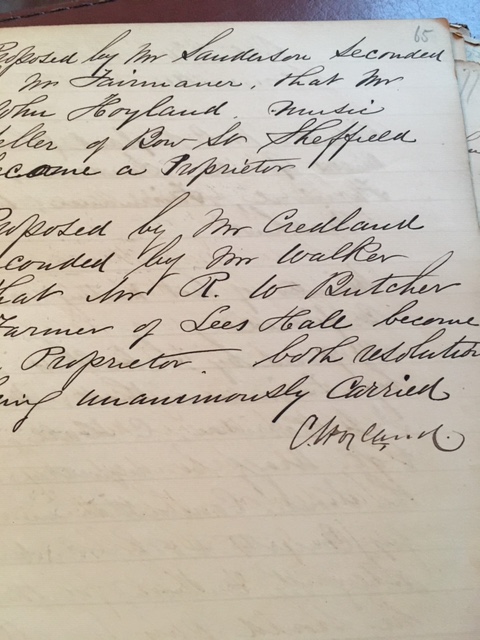
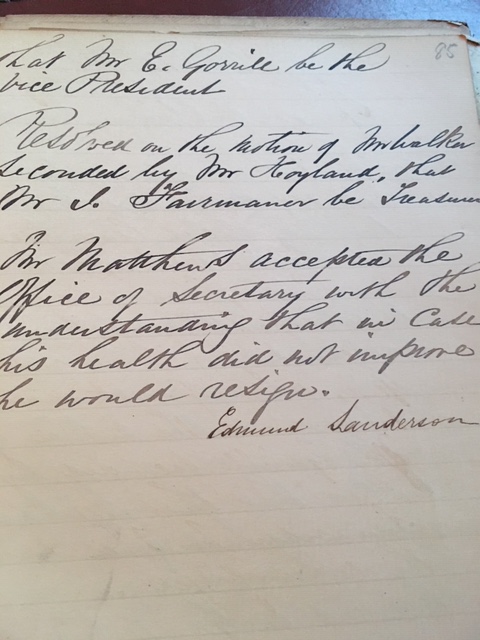
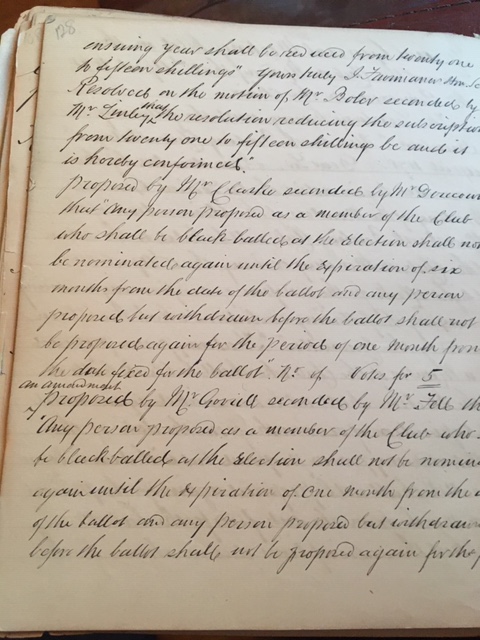
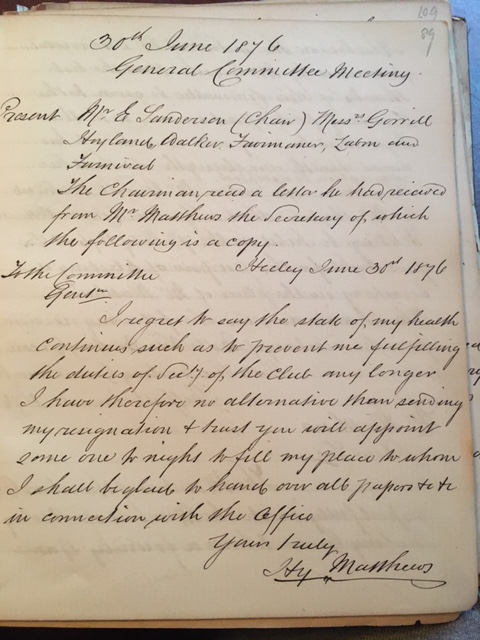
Several years ago, in a carrier bag, under a bench seat in the TV room and covered in dust, we found the first 2 minute books of Meersbrook Bowling Club. These minutes cover the years 1874 to 1884 and these wonderful documents are now very fragile, but written quite beautifully in ink pen and it is a honour that they were entrusted to me for temporary safekeeping. A previous past Director had summarised some of the content in a document but we don’t possess a copy of this electronically. So during this strange period of time in as we reel from the covid-19 pandemic, I have taken the opportunity to study these historical documents and revise the first ten years history of MBC. As you can imagine, the world was quite different in those days, but also strangely similar in some cases! I hope you enjoy this little journey back to Victorian Sheffield and Meersbrook as much as I have, and meet some new ‘old’ characters along the way.
Ian Christopherson
Beginnings: October 1874
In 1874 Queen Victoria was in the thirty seventh year of her reign as Monarch. It was a general election year, with William Gladstone’s Liberals losing out to Benjamin Disraeli and the Conservatives.
On Wednesday 7th October, the Sheffield & Rotherham Independent reported that election riots in the town of Northampton had resulted in the Army being called into action as the Riot Act was read. Meanwhile in Sheffield, a local Butcher from St. Phillips Road was arrested on charges of sheep rustling from a field in Crookes.
The Sheffield Daily Telegraph had reports of the new Licensing Act, this meant ‘country’ pubs had to close by 10pm while ‘town’ pubs were allowed an extra hour’s grace closing at 11pm. Earlier that day at Ecclesall, the Funeral of Mr. George Brown took place. George Brown was the Nephew of the famous John Brown, who had steelworks in Sheffield and shipyards on the Clyde in Glasgow. George Brown founded the Brown, Bayley & Dixon works on Leeds Road near where the Olympic Legacy Park is now situated. Local press also reported occurrences of ‘rattening,’ a form of industrial sabotage where a Razor Grinder had his wheel and drive belt stolen and a Saw Grinder had his wheel damaged.
Later that evening in the Sheaf Street Schoolrooms a meeting was held at which Meersbrook Bowling Club was founded. The location of these School Rooms is not exactly known, this Sheaf Street itself extended from Ann’s Road to London Road and it is now part of Gleadless Road. At the meeting, Mr. Alfred Sellars had the chair. Little is known about him apart from the fact he resided at Victoria Villa, Victoria Road. Victoria Road changed its name at some time between 1874 and 1884 to Shirebrook Road. What we can say that he must have been a man of means to have resided in a large house in a salubrious part of the City. And there, just as quick as he joins the story, the mysterious Mr. Sellars leaves it. Despite the fact he lived on the club’s doorstep he never joined the membership, did not become a shareholder, and is never mentioned in any surviving meeting minutes again!
Alfred Sellars from the chair introduced a new speaker, Mr. Edward Gorill who lived at Brighton Villa on Victoria Road. Mr. Gorill was a scissor manufacturer of Robert Gorill & Sons and went on to inform the meeting of the steps already taken to form a ‘Bowling Green Club’ in Heeley.
Minutes from the first meeting
The next speaker was Mr. Henry Matthews, an Architect and Surveyor, also residing on Victoria Road at Melrose Villa. Mr. Matthews explained plans for the necessary buildings, giving estimations of ‘probable receipts and disbursements’ of the club.
The meeting then agreed ‘that a proprietary club be formed’ with shares being issued at a value of ‘£5 each should be issued, the number to be limited to 150 shares’. Share were to be paid for in the following way: ‘ten shillings down, ten shillings on the 1st December next, and £1 on the first day of January, February, March and April 1875. The title for the new club was decided as ‘The Meersbrook Proprietary Bowling Green’ though this was changed in a very short time to ‘Meersbrook Bowling Green Club’ It appeared that this was the title up to 1884 when the club was incorporated as a limited company, remaining to this day as ‘Meersbrook Bowling Club Limited.’
It was resolved at that first meeting that an Annual General Meeting would be held in May of each year, and that the following gentlemen would form a committee:
Mr Edward Gorill and Mr Edward Matthews, whom we have already met.
Mr Edmund H Sanderson an accountant of E. Sanderson and Son. Mr Sanderson’s home address was Arundel Villas, Victoria Rd and his neighbour in Arundel Villas was the American consul in Sheffield, Dr. Claudius Buchanan Webster.
Mr Charles Hoyland, brush maker whose factory was at 97 to 99 Queen St and his home was Kent House, 98 Kent Rd now numbered 106.
Mr Thomas Vernon, a Cork manufacturer with premises at 2 Union St, home address 119 Kent Rd now 275 Albert Rd.
Mr Samuel Walker of Lambert St.
Mr Thomas Credland, a timber merchant and marble chimneypiece manufacturer of Heeley Bridge works, 376 London Rd.
The remaining two members of the of the original committee were a Mr Barrows and Mr JD Harrison about whom nothing is known, except that Mr Barrows took a trip to Derby to inspect some buildings made of a special type of white brick in which the club was interested.
There we meet the founding fathers of the Meersbrook Bowling Club, they were all successful men, businessmen and professionals. Victorian gentleman who saw the club as a desirable asset to their neighbourhood. These men laid the foundations of the club with such care for its security that it is still in existence and flourishing today.
The Foundations are Laid
Two days later the 9th of October 1874, a further meeting was held the Red Lion Inn on London Road, this was the first committee meeting. All the committee were present except Thomas Vernon and JD Harrison who ended up both resigning from the committee before the end of the year. Mr Hoyland was voted President, Mr Gorill Vice-President, Mr Sanderson became Treasurer and Mr Matthews became Secretary, all these men lived close to the site of the club.
At this meeting, the committee bought the land on which the club was to be built. It was a plot belonging to the accountant Edmund H Sanderson. Mr Sanderson stated that he could not take less than five shillings per superficial yard, but in consideration of the plot being large and the object of this venture a very desirable one, he would supply all the cash required for carrying out the works and also allow the purchase money of the land to remain unpaid until the 1st of May 1875 without charge. After this time, the remaining unpaid money should bear interest at the rate of 5% per annum. A very shrewd man seems Mr Sanderson! The club’s Solicitors Messrs Smith and Hind prepared an agreement and the deed was done! Agreement was reached that workman be employed to start levelling the ground immediately.
The further meeting at the Red Lion was held on the 17th of October, 10 days after the original meeting in the School Rooms it was reported that the work of levelling was progressing satisfactorily. Trustees were appointed to their positions and Henry Matthews was made architect and surveyor of the club property. Legend has it that Mr Matthews was an Architect for the Railways and that is why the club building resembles a Railway Station, but no evidence has been found in the minutes to confirm this. It is a good story regardless, and if you look carefully enough you can still see ‘the platform’ underneath the present-day Conservatory.
It was decided to open an account with the London and Yorkshire Banking Co. Ltd, Sheffield. All accounts of £2.00 and upwards “shall be paid by cheque, signed by President, Vice President, Secretary and one committee member”. The Treasurer was empowered to pay “all datal wages upon receipt of the Architect’s certificate” and the Secretary was “empowered to provide all requisite books and stationery”. The committee decided to meet every Friday night at 8:30 prompt, latecomers were to be fined, anyone not in attendance at 8:35 were to be fined 3 pence, and if anyone so dared to be as late as nine o’clock, they were to be fined a hefty sixpence!
Election to the club was to be decided by ballot among the committee: “2 black balls shall exclude”, this was a practice that was carried out at the club for many years with potential members running the gauntlet to avoid being blackballed! At this meeting we meet the club’s very first two members who were admitted by the newly formed committee. They were Joseph John Earnshaw a Coal Agent for the Dronfield Silkstone Coal Company at Heeley station and he lived on Well Rd. The other newly admitted member was John Figorski, a cabinet case manufacturer with premises on Watson Walk and he lived at 95 William St.
Another piece of business transacted at this meeting is of interest to the many Snooker Players who have played the tables at the Bowling Club, and this decision was very important to the future of the club. It was decided to make alterations to the architects plans to allow for two tables in the billiard room and Edmund Sanderson’s hand can be seen again in this decision, as he was so determined to have two billiard tables in the premises he later bought one of the tables from out of his own pocket. We can imagine that the shrewd Mr Sanderson had probably calculated that the 5% interest accrued on the building loan would cover his expenditure!
In the busy month of October 1874 there were two further meetings on the 23rd and 30th of October. During this time period the site was being levelled and the retaining walls were being built. During November, the committee spent time discussing the use of white bricks in the construction of the clubhouse. A friend of Mr Sanderson who lived in Northampton, reported on the advantages and disadvantages of white bricks. “They have to be neatly laid by a skilled Craftsman otherwise they soil with handling; they should be well protected by a cornice and no water spout should be likely to flow on them; but they are very striking in appearance, especially if laid in panels along with red bricks”. Mr Barrows had inspected some buildings incorporating white bricks in Derby and he espoused that he was very satisfied with them. The committee resolved to face the club with the white bricks purchased from Tera Cotta Company, Coalville and dressed in red bricks from the same source, and the striking results can be seen to this day.
At a meeting in the Red Lion on the 4th of December 1874 the committee adopted the architect specifications and resolved to advertise for tenders for building the clubhouse. Advertisements were made, four times in the Telegraph and the Independent and once in the Post. There were 19 tenders for the work but only one, from Foxton Brothers, for the whole work whose tender was £1051.00. Most tenders received were for a part of the work, there were tenders for joiners’ work ranging from £295 and 15 shillings to £335. The roof slaters tenders ranged from £67 to £71, plasterers from £57 to £67, plumbers £95 to £120 and painters from £22 to £26.
The total cost of the building came to £886.5.0 and the successful tenders received were from:
James Wilkinson, for bricklayers’, masons’ and joiners’ work: £650
Staniforth and Lee, for roof slating: £68
C Unwin & Son, for plastering: £49.15.0
JT Taylor, for plumbing: £95
GE Bennett, for painting: £23.10.0
For the following three months there were no more meetings, presumably to give time for the club construction to progress. On 27th of March 1875 the committee met for the last time in the Red Lion and discussed advertising for a steward and stewardess and to get tenders for the laying of the Bowling Green. Again, advertisements were placed in the Sheffield Telegraph, the Independent and the Post. All meetings from this time forward were held in the new clubhouse. The topic of discussion with the 13 applications for posts of steward and stewardess and these were mostly from the Sheffield area. Applications were all also received from Doncaster and one from Bridlington Quay. All applicants had been has asked to say what salary they would expect, and expectations ranged from 18 shillings a week from George Andrews of Walkley, to 70 or 80 pounds per year. One applicant, C Barker of the Saint George’s club, “could not say” what he wanted! A shortlist of four was drawn up and the company secretary was instructed to write for references. At a following meeting on the 16th of April, it was decided to appoint Charles Boler and his Wife of Franklin St, and they were to be paid a weekly salary of “20 shillings plus all profits arising from the sale of unexcisable articles to members”.
The advertisements to tender for laying the Bowling Green brought three replies. One from James Bower offered to do the job for £34 & 16 shillings, William Markham would charge tuppence halfpenny per yard for spreading soil and fourpence halfpenny per yard for turf. A Mr Pepper quoted seven pence & three farthings per yard for the whole work. The secretary and some of the committee members met with William Markham, and on the 23rd of April he was given the work.
Edmund Sanderson we have previously learned, persuaded the committee to amend architectural plans to make room for two billiards tables and at the first meeting in the new clubhouse on the 9th of April 1875 he offered to pay for one of the tables so it is fair to say that Mr Sanderson was obviously a keen billiards player. The committee agreed to buy two ‘Specialite’ tables from Burroughs & Watts of Manchester and these had a cost of 72 Guineas each with fixing being three Guineas extra.
With the spring of 1875 a renewed period of activity began. Between the 9th of April to the end of May the committee met no less than eleven times, appointing Steward and Stewardess, having the green laid, installing the billiard tables, preparing the rules of the club and furnishing the club saloon. The floor of the saloon was covered with ‘Suberium’, a floor covering made from Cork at a cost of four shillings per yard, accept under the billiard tables where an oil cloth was used. The floor of the boardroom, which is now the TV room, was covered with drugget, a coarse woven and felted woollen fabric along with a hearth rug. Fenders and pokers were supplied for the saloon fires along with a set of fire irons for the boardroom, green Venetian blinds were fitted to the windows of the saloon and the billiard room. The saloon was furnished with Seven tables, a dozen armchairs and three dozen small chairs. Arrangements were also made to erect a flagpole on the premises, and this can be seen in several of the watercolour paintings we have of the club. Although no longer feature of the club the flagpole did remain a feature up until the early 1980s.
Administration and Management: The first Annual General Meeting.
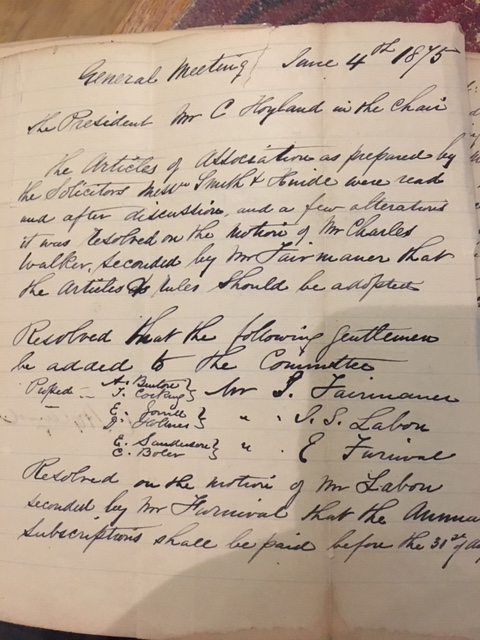
On the 4th of June 1875 the first Annual General Meeting was held. The president, Mr Charles Hoyland took the chair. At this time 36 men had joined the membership of the club, but two Messrs Harrison and Vernon had resigned. The ‘Articles of Association’ were read and discussed, and alterations were made before they were fully adopted. Unfortunately, we do not have a copy of the original articles, but it would be interesting to see a copy. Under their rules a member who resigned his membership was able to keep his share but we are unsure as to what value it had at that time, nowhere in the minutes of the first ten years is there any indication that the club ever paid a dividend to shareholders. Some current shareholders may comment that nothing has changed up to the present day! It is fair to say however that there have been several share issues since the original shares were issued in 1874, but it would be of historical interest to see one of these original share certificates as a part of the clubs history. At a committee meeting in May 1876 the secretary read a letter from a Mr Leonard A Ryalls of North Church Street who had bought a £5 share. He did not want to pay the 21 shillings per annum subscription, and he had no intention of using the Bowling Green, however he made it clear he did expect to receive any dividends owing! The committee resolved to accept the suggestion but again there is no mention of any dividends in the minutes perhaps its only value was that of entitling the shareholder to a share of the proceeds in case the club was wound up.
At that very first AGM it was also resolved that subscriptions be paid before the 31st of August and three names were added to the committee, and they were interesting names to say the least:
The exotically named, Mr Jabez Fairmaner of 181 Cemetery Rd, who was chief clerk of the County court.
The intriguingly named, Mr Joseph Sales Labon, a Manager, of 21 Gleadless Rd.
And finally, the ordinarily named, Mr Edward Furnival, of Furnival & Ibbotson, who lived at 25 Broadfield Rd.
Minutes of the first AGM
It would be fair to say that in those early days the organisational structure was fluid and an example of this can be seen in a motion from the committee meeting on the 16th of June in which the committee divided itself into three subcommittees. These being: Finance, House and Green. The duties of each were set out at later meetings but in summary; the Finance committee would arrange payment of all accounts in due course and do everything pertaining to cash transactions of the club. The House committee would bottle all spirits etc required by the Steward, order ale, spirits, beers, cigars and generally superintend internal management of the club. The green committee would superintend the management of the grounds and give instructions to the steward as to the rolling, mowing, seeding of the bowling green, and every other matter connected with the external business of the club within the boundary walls.
It is interesting as a current Director of MBC, to note the similarity between the original 1870’s setup and how the current organisation is structured since we became self-managed back in December 2017. Though, in a sign of current times, there are a lot less bodies doing the doing now!
The House committee’s duty filling bottles with spirits throws an interesting light on the bar practice in the club in those early days. In an earlier meeting Edmund Sanderson and Edward Gorrill had been appointed to visit Beatson & Company’s glass works in Rotherham where they were instructed to inquire about “small decanters or spirit bottles”. They reported their findings back to the meeting of the 29th of May and the secretary was instructed to order 3 gross of small decanters at 25 shillings per gross, subject to 5% discount for cash. It would be interesting to know if these are the small bottles listed in the early bar tariff on the following page, and it would also be interesting to know how much liquid was contained in those small bottles. We know that the club bought Irish whiskey by the quarter cask, shipped from Cork in Ireland for 15 shillings per gallon or roughly 1 penny per ounce. If the small bottle held three 3 ounces and sold for fourpence the profit would be a little more than 15%. Would that be a margin likely to satisfy the operations of a small private club in the 1870s?
How much does it cost to get a drink in this place?
The scale of charges and bar tariff was fixed at two meetings in June, they were as follows:
Brandy, Rum, Scotch whisky, Irish whiskey: 4d per small bottle
Gin: 3d per small bottle
Bottled beer: 3d per bottle
Draft beer: 2d per glass
Sherry & Port: two shillings and sixpence per pint, three shillings and ninepence per bottle
Hock: one shilling and sixpence per pint bottle
Claret: one shilling and threepence per pint bottle
Lemonade: 2d
Schweppes lemonade: 4d
Soda water: 3d
Schweppes soda water: 4d
Cup of tea: 2d
Tea with bread and butter or toast: 6d
Chops with plain bread: 8d
Steak (rump) with plain bread: 10d
Welsh rarebit: 4d
This all sounds remarkably civilised, And I must admit I can’t really imagine in this day and age coming off the green after a hard fought battle against Bradfield or Meersbrook Park in the Meersbrook Derby and exclaiming to whoever is serving at the bar:
“My good man / lady! One of your finest Rumps steaks with plain bread if you please, medium rare, and a Welsh Rarebit for my worthy opponent!”
Part 2 to follow soon. IC.




 Meersbrook Bowling Club Limited
You must be logged in to post a comment.