A History of the Meersbrook Bowling Club Limited
The first ten years (REVISED)
Ian Christopherson |Company Director | 31/03/2020
I know history isn’t everybody’s thing, but when we consider that we nearly lost MBC forever, and also remember some of the huge characters in bowls we’ve lost in just this last year or so, I ask one thing. Where would we be without bowls clubs and bowls characters? Our clubs and pavilions around the UK are covered in photos of wonderful bowlers and characters that are a part of all our history, and as we reflect during these strange and troubled times in 2020, long may they all be remembered.
Several years ago, in a carrier bag, under a bench seat in the TV room and covered in dust, we found the first two minute books of Meersbrook Bowling Club. These minutes cover the years 1874 to 1884 and these wonderful documents are now very fragile, but written quite beautifully in ink pen and it is a honour that they were entrusted to me for temporary safekeeping. A previous past Director had summarised some of the content in a document but we don’t possess a copy of this electronically. So during this strange period of time in as we reel from the covid-19 pandemic, I have taken the opportunity to study these historical documents and revise the first ten years history of MBC. As you can imagine, the world was quite different in those days, but also strangely similar in some cases! I hope you enjoy this little journey back to Victorian Sheffield and Meersbrook as much as I have, and meet some new ‘old’ characters along the way.
Ian Christopherson
Beginnings: October 1874
In 1874 Queen Victoria was in the thirty seventh year of her reign as Monarch. It was a general election year, with William Gladstone’s Liberals losing out to Benjamin Disraeli and the Conservatives.
On Wednesday 7th October, the Sheffield & Rotherham Independent reported that election riots in the town of Northampton had resulted in the Army being called into action as the Riot Act was read. Meanwhile in Sheffield, a local Butcher from St. Phillips Road was arrested on charges of sheep rustling from a field in Crookes.
The Sheffield Daily Telegraph had reports of the new Licensing Act, this meant ‘country’ pubs had to close by 10pm while ‘town’ pubs were allowed an extra hour’s grace closing at 11pm. Earlier that day at Ecclesall, the Funeral of Mr. George Brown took place. George Brown was the Nephew of the famous John Brown, who had steelworks in Sheffield and shipyards on the Clyde in Glasgow. George Brown founded the Brown, Bayley & Dixon works on Leeds Road near where the Olympic Legacy Park is now situated. Local press also reported occurrences of ‘rattening,’ a form of industrial sabotage where a Razor Grinder had his wheel and drive belt stolen and a Saw Grinder had his wheel damaged.
Later that evening in the Sheaf Street Schoolrooms a meeting was held at which Meersbrook Bowling Club was founded. The location of these School Rooms is not exactly known, this Sheaf Street itself extended from Ann’s Road to London Road and it is now part of Gleadless Road. At the meeting, Mr. Alfred Sellars had the chair. Little is known about him apart from the fact he resided at Victoria Villa, Victoria Road. Victoria Road changed its name at some time between 1874 and 1884 to Shirebrook Road. What we can say is that he must have been a man of means to have resided in a large house in a salubrious part of the City. And there, just as quick as he joins the story, the mysterious Mr. Sellars leaves it. Despite the fact he lived on the doorstep he never joined the membership, did not become a shareholder, and is never mentioned in any surviving meeting minutes again!
Alfred Sellars from the chair introduced a new speaker, Mr. Edward Gorill who lived at Brighton Villa on Victoria Road. Mr. Gorill was a scissor manufacturer of Robert Gorill & Sons and went on to inform the meeting of the steps already taken to form a ‘Bowling Green Club’ in Heeley.
Minutes from the first meeting


The next speaker was Mr. Henry Matthews, an Architect and Surveyor, also residing on Victoria Road at Melrose Villa. Mr. Matthews explained plans for the necessary buildings, giving estimations of ‘probable receipts and disbursements’ of the club.
The meeting then agreed ‘that a proprietary club be formed’ with shares being issued at a value of ‘£5 each should be issued, the number to be limited to 150 shares’. Shares were to be paid for in the following way: ‘ten shillings down, ten shillings on the 1st December next, and £1 on the first day of January, February, March and April 1875. The title for the new club was decided as ‘The Meersbrook Proprietary Bowling Green’ though this was changed in a very short time to ‘Meersbrook Bowling Green Club’. It appeared that this was the title up to 1884 when the club was incorporated as a limited company, remaining to this day as ‘Meersbrook Bowling Club Limited.’
It was resolved at that first meeting that an Annual General Meeting would be held in May of each year, and that the following gentlemen would form a committee:
Mr Edward Gorill and Mr Edward Matthews whom we have already met.
Mr Edmund H Sanderson an accountant of E. Sanderson and Son. Mr Sanderson’s home address was Arundel Villas, Victoria Rd and his neighbour in Arundel Villas was the American consul in Sheffield, Dr Claudius Buchanan Webster.
Mr Charles Hoyland, brush maker whose factory was at 97 to 99 Queen St and his home was Kent House, 98 Kent Rd now numbered 106.
Mr Thomas Vernon, a Cork manufacturer with premises at 2 Union St, home address 119 Kent Rd now 275 Albert Rd.
Mr Samuel Walker of Lambert St.
Mr Thomas Credland, a timber merchant and marble chimneypiece manufacturer of Heeley Bridge works, 376 London Rd.
The remaining two members of the original committee were a Mr Barrows and Mr JD Harrison about whom nothing is known, except that Mr Barrows took a trip to Derby to inspect some buildings made of a special type of white brick in which the club was interested.
There we meet the founding fathers of the Meersbrook Bowling Club, they were all successful men, businessmen and professionals. Victorian gentleman who saw the club as a desirable asset to their neighbourhood. These men laid the foundations of the club with such care for its security that it is still in existence and flourishing today.
The Foundations are Laid
Two days later the 9th of October 1874, a further meeting was held at the Red Lion Inn on London Road, this was the first committee meeting. All the committee were present except Thomas Vernon and JD Harrison who ended up both resigning from the committee before the end of the year. Mr Hoyland was voted President, Mr Gorill Vice-President, Mr Sanderson became Treasurer and Mr Matthews became Secretary, all these men lived close to the site of the club.
At this meeting, the committee bought the land on which the club was to be built. It was a plot belonging to the accountant Edmund H Sanderson. Mr Sanderson stated that he could not take less than five shillings per superficial yard, but in consideration of the plot being large and the object of this venture a very desirable one, he would supply all the cash required for carrying out the works and also allow the purchase money of the land to remain unpaid until the 1st of May 1875 without charge. After this time, the remaining unpaid money should bear interest at the rate of 5% per annum. A very shrewd man seems Mr Sanderson! The club’s Solicitors Messrs Smith and Hind prepared an agreement, and the deed was done! Agreement was reached that workman be employed to start levelling the ground immediately.
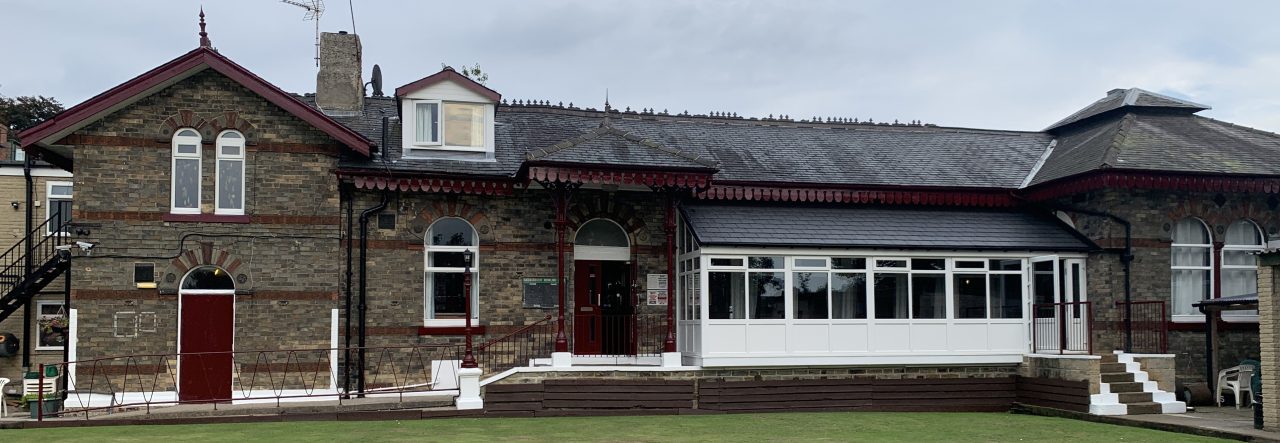
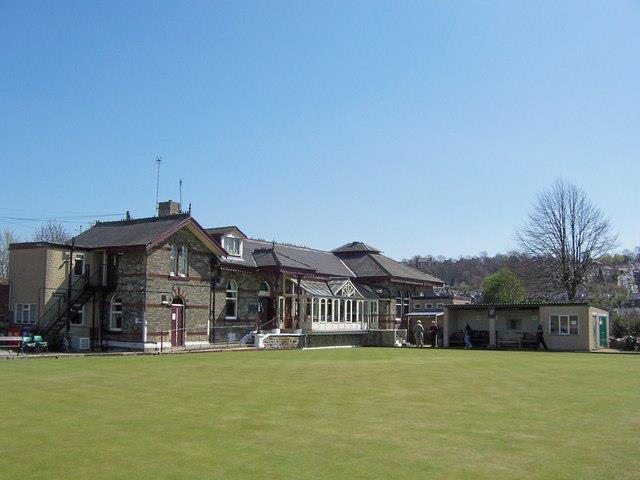
The further meeting at the Red Lion was held on the 17th of October, 10 days after the original meeting in the School Rooms, and it was reported that the work of levelling was progressing satisfactorily. Trustees were appointed to their positions and Henry Matthews was made architect and surveyor of the club property. Legend has it that Mr Matthews was an Architect for the Railways and that is why the club building resembles a Railway Station, but no evidence has been found in the minutes to confirm this. It is a good story regardless, and if you look carefully enough you can still see ‘the platform’ underneath the present-day Conservatory.
It was decided to open an account with the London and Yorkshire Banking Co. Ltd, Sheffield. All accounts of £2.00 and upwards “shall be paid by cheque, signed by President, Vice President, Secretary and one committee member”. The Treasurer was empowered to pay “all datal wages upon receipt of the Architect’s certificate” and the Secretary was “empowered to provide all requisite books and stationery”. The committee decided to meet every Friday night at 8:30 prompt, latecomers were to be fined, anyone not in attendance at 8:35 were to be fined 3 pence, and if anyone so dared to be as late as nine o’clock, they were to be fined a hefty sixpence!
Election to the club was to be decided by ballot among the committee: “2 black balls shall exclude”, this was a practice that was carried out at the club for many years with potential members running the gauntlet to avoid being blackballed! At this meeting we meet the club’s very first two members who were admitted by the newly formed committee. They were Joseph John Earnshaw, a Coal Agent for the Dronfield Silkstone Coal Company at Heeley station and he lived on Well Rd. The other newly admitted member was John Figorski, a cabinet case manufacturer with premises on Watson Walk and he lived at 95 William St.
A further piece of business transacted at this meeting is of interest to the many Snooker players who have played the tables at the Bowling Club, and this decision was very important to the future of the club. It was decided to make alterations to the architects plans to allow for two tables in the billiard room, and Edmund Sanderson’s hand can be seen again in this decision, as he was so determined to have two billiard tables in the premises he later bought one of the tables from out of his own pocket. We can imagine that the shrewd Mr Sanderson had probably calculated that the 5% interest accrued on the building loan would cover his expenditure!
In the busy month of October 1874 there were two further meetings on the 23rd and 30th of October. During this period the site was being levelled and the retaining walls were being built. During November, the committee spent time discussing the use of white bricks in the construction of the clubhouse. A friend of Mr Sanderson who lived in Northampton, reported on the advantages and disadvantages of white bricks. “They have to be neatly laid by a skilled Craftsman otherwise they soil with handling; they should be well protected by a cornice and no water spout should be likely to flow on them; but they are very striking in appearance, especially if laid in panels along with red bricks”. Mr Barrows had inspected some buildings incorporating white bricks in Derby and he espoused that he was very satisfied with them. The committee resolved to face the club with the white bricks purchased from Tera Cotta Company, Coalville and dressed in red bricks from the same source, and the striking results can be seen to this day.
At a meeting in the Red Lion on the 4th of December 1874 the committee adopted the architect specifications and resolved to advertise for tenders for building the clubhouse. Advertisements were made, four times in the Telegraph and the Independent, and once in the Post. There were 19 tenders for the work but only one, from Foxton Brothers, for the whole work whose tender was £1051.00. Most tenders received were for a part of the work, there were tenders for joiners’ work ranging from £295 and 15 shillings to £335. The roof slaters tenders ranged from £67 to £71, plasterers from £57 to £67, plumbers £95 to £120 and painters from £22 to £26.
The total cost of the building came to £886.5.0 and the successful tenders received were from:
James Wilkinson, for bricklayers’, masons’ and joiners’ work: £650
Staniforth and Lee, for roof slating: £68
C Unwin & Son, for plastering: £49.15.0
JT Taylor, for plumbing: £95
GE Bennett, for painting: £23.10.0
For the following three months there were no more meetings, presumably to give time for the club construction to progress. On 27th of March 1875 the committee met for the last time in the Red Lion and discussed advertising for a steward and stewardess and to get tenders for the laying of the Bowling Green. Again, advertisements were placed in the Sheffield Telegraph, the Independent and the Post. All meetings from this time forward were held in the new clubhouse. The main topic of discussion was the 13 applications for posts of steward and stewardess, and these were mostly from the Sheffield area. Applications were also received from Doncaster and one from Bridlington Quay. All applicants had been asked to say what salary they would expect, and expectations ranged from 18 shillings a week from George Andrews of Walkley, to 70 or 80 pounds per year. One applicant, C Barker of the Saint George’s club, “could not say” what he wanted! A shortlist of four was drawn up and the company secretary was instructed to write for references. At a following meeting on the 16th of April, it was decided to appoint Charles Boler and his Wife of Franklin St, and they were to be paid a weekly salary of “20 shillings plus all profits arising from the sale of unexcisable articles to members”.
The advertisements to tender for laying the Bowling Green brought three replies. One from James Bower offered to do the job for £34 & 16 shillings, William Markham would charge tuppence halfpenny per yard for spreading soil and fourpence halfpenny per yard for turf. A Mr Pepper quoted seven pence & three farthings per yard for the whole work. The secretary and some of the committee members met with William Markham, and on the 23rd of April he was given the work.
Edmund Sanderson we have previously learned, persuaded the committee to amend architectural plans to make room for two billiards tables, and at the first meeting in the new clubhouse on the 9th of April 1875 he offered to pay for one of the tables so it is fair to say that Mr Sanderson was obviously a keen billiards player. The committee agreed to buy two ‘Specialite’ tables from Burroughs & Watts of Manchester and these had a cost of 72 Guineas each with fixing being three Guineas extra.
With the spring of 1875 a renewed period of activity began. Between the 9th of April to the end of May the committee met no less than eleven times, appointing Steward and Stewardess, having the green laid, installing the billiard tables, preparing the rules of the club and furnishing the club saloon. The floor of the saloon was covered with ‘Suberium’, a floor covering made from Cork at a cost of four shillings per yard, accept under the billiard tables where an oil cloth was used. The floor of the boardroom, which is now the TV room, was covered with drugget, a coarse woven and felted woollen fabric along with a hearth rug. Fenders and pokers were supplied for the saloon fires along with a set of fire irons for the boardroom, green Venetian blinds were fitted to the windows of the saloon and the billiard room. The saloon was furnished with Seven tables, a dozen armchairs and three dozen small chairs. Arrangements were also made to erect a flagpole on the premises, and this can be seen in several of the watercolour paintings we have of the club. Although no longer a feature of the club the flagpole did remain in place up until the early 1980’s.
Administration and Management: The first Annual General Meeting.
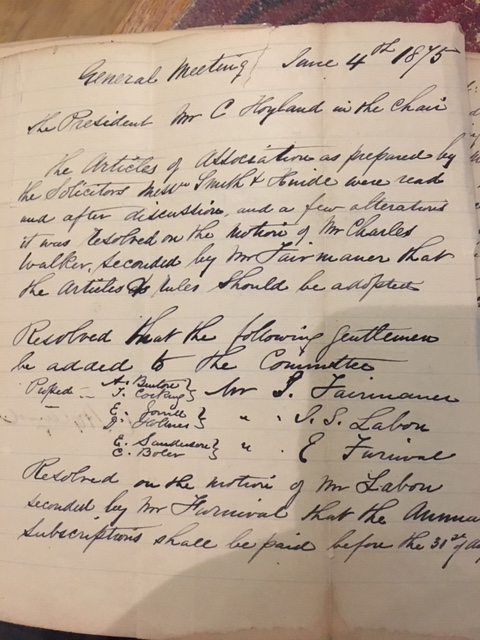
On the 4th of June 1875 the first Annual General Meeting was held. The president, Mr Charles Hoyland took the chair. At this time 36 men had joined the membership of the club, but two Messrs Harrison and Vernon had resigned. The ‘Articles of Association’ were read and discussed, and alterations were made before they were fully adopted. Unfortunately, we do not have a copy of the original articles, but it would be interesting to see a copy. Under their rules a member who resigned his membership was able to keep his share but we are unsure as to what value it had at that time, nowhere in the minutes of the first ten years is there any indication that the club ever paid a dividend to shareholders. Some current shareholders may comment that nothing has changed up to the present day! It is fair to say however that there have been several share issues since the original shares were issued in 1874, but it would be of historical interest to see one of these original share certificates as a part of the clubs history. At a committee meeting in May 1876 the secretary read a letter from a Mr Leonard A Ryalls of North Church Street who had bought a £5 share. He did not want to pay the 21 shillings per annum subscription, and he had no intention of using the Bowling Green however he made it clear he did expect to receive any dividends owing! The committee resolved to accept the suggestion but again there is no mention of any dividends in the minutes perhaps its only value was that of entitling the shareholder to a share of the proceeds in case the club was wound up.
At that very first AGM it was also resolved that subscriptions be paid before the 31st of August and three names were added to the committee, and they were interesting names to say the least:
The exotically named, Mr Jabez Fairmaner of 181 Cemetery Rd, who was chief clerk of the County court.
The intriguingly named, Mr Joseph Sales Labon, a Manager, of 21 Gleadless Rd.
And finally, the ordinarily named, Mr Edward Furnival, of Furnival & Ibbotson, who lived at 25 Broadfield Rd.
Minutes of the first AGM
It would be fair to say that in those early days the organisational structure was fluid, and an example of this can be seen in a motion from the committee meeting on the 16th of June in which the committee divided itself into three subcommittees. These being: Finance, House and Green. The duties of each were set out at later meetings but in summary; the Finance committee would arrange payment of all accounts in due course and do everything pertaining to cash transactions of the club. The House committee would bottle all spirits required by the Steward, order ale, spirits, beers, cigars and generally superintend internal management of the club. The green committee would superintend the management of the grounds, and give instructions to the steward as to the rolling, mowing, seeding of the bowling green, and every other matter connected with the external business of the club within the boundary walls.
It is interesting as a current Director of MBC to note the similarity between the original 1870’s setup and how the current organisation is structured since we became self-managed back in December 2017. Though, in a sign of current times, there are a lot less bodies doing the doing now!
The House committee’s duty filling bottles with spirits throws an interesting light on the bar practice in the club in those early days. In an earlier meeting Edmund Sanderson and Edward Gorrill had been appointed to visit Beatson & Company’s glass works in Rotherham where they were instructed to inquire about “small decanters or spirit bottles”. They reported their findings back to the meeting of the 29th of May and the secretary was instructed to order 3 gross of small decanters at 25 shillings per gross, subject to 5% discount for cash. It would be interesting to know if these are the small bottles listed in the early bar tariff on the following page, and it would also be interesting to know how much liquid was contained in those small bottles. We know that the club bought Irish whiskey by the quarter cask, shipped from Cork in Ireland for 15 shillings per gallon or roughly 1 penny per ounce. If the small bottle held three 3 ounces and sold for fourpence the profit would be a little more than 15%. Would that be a margin likely to satisfy the operations of a small private club in the 1870’s?
How much does it cost to get a drink in this place?
The scale of charges and bar tariff was fixed at two meetings in June, they were as follows:
Brandy, Rum, Scotch whisky, Irish whiskey: 4d per small bottle
Gin: 3d per small bottle
Bottled beer: 3d per bottle
Draft beer: 2d per glass
Sherry & Port: two shillings and sixpence per pint, three shillings and ninepence per bottle
Hock: one shilling and sixpence per pint bottle
Claret: one shilling and threepence per pint bottle
Lemonade: 2d
Schweppes lemonade: 4d
Soda water: 3d
Schweppes soda water: 4d
Cup of tea: 2d
Tea with bread and butter or toast: 6d
Chops with plain bread: 8d
Steak (rump) with plain bread: 10d
Welsh rarebit: 4d
This all sounds remarkably civilised, And I must admit I can’t really imagine in this day and age coming off the green after a hard fought battle against Bradfield or Meersbrook Park in the Meersbrook Derby and exclaiming to whoever is serving at the bar: “My good man / lady! One of your finest Rumps steaks with plain bread if you please, medium rare, and a Welsh Rarebit for my worthy opponent!”
From little acorns…
Over the next 10 years 130 new members were admitted to the club as the membership steadily grew. Many of these new members were local industrialists, amongst these were cutlery, file and saw manufacturers and some were probably what were known in Sheffield as ‘Little Mesters’ and these industries although some long gone, are synonymous with the historical industrial legacy of Sheffield. It may be of local interest for our members and people who are familiar with the Bowling Club to note the addresses and residences of the committee members we have met so far, who lived in the surrounding area of MBC. Of further interest to members and people who live in and around the Meersbrook area of today would be to note some of the names and addresses of some of the members who joined during the 1870’s and 1880’s and to potentially see what the residents of their current addresses were up to back in those Victorian times. Let us meet a few of them now:
John James Barton, a saw maker of 3 Alexander Rd
John Batt, a manufacturer of silver-plated spoons, forks, desserts and fish carvers of 8 Albert Rd.
Thomas Radley Cadman, razor maker of 6 Sheaf Gardens
Charles Cleg, saw and file maker, of Myrtle Rd
James Gallimore, a silversmith of 15 Albert road
Frederick Hemingway, file cutter, of 30 Sheaf Gardens Terrace
William Henry, a maker of pen and pocket blades, of Solly St
Richard Jervis, an Iron Founder and Cutler, of Glen View, Victoria Rd (Shirebrook Rd).
Joseph Kay, table knife hafter, 64 Wellington St
Samuel Marshall, manufacturer of sheep shears, scythes and machine knives, of 218 Victoria St
This is an example of the many interesting people living in and around the Meersbrook area at that time and gives us a glimpse of what they were up to in their working lives as well as their leisure time.
Amongst the eclectic fledgling membership of MBC were professional men including: a Dentist, two Doctors, an Artist, and a Professor of music. There was a Farmer residing at nearby Lees Hall at Norton, a Pawnbroker from London Rd and a Cattle Dealer from Ecclesall Rd. There were also the Landlords of the nearby Wagon & Horses and White Lion Public Houses, who possibly used their membership of MBC to enable them to have a drink and leisure time somewhere different from their own licensed premises, but not too far away in case they were called upon! Many of the growing membership gave their occupations as Manager or Clerk, and there were several cabinet case makers, presumably making cases for cutlery or blades. We can easily imagine that these cases went on to contain the cutlery made by some of the members named previously.
A Grand Opening for two shillings and sixpence!
The social life of the new club was inaugurated with an opening dinner for which the steward was instructed to provide a bill of fare for two shillings and sixpence. Dinner was to be on the table at 7:00pm prompt. The members were to be offered:
Salmon with parsley butter
Roast beef and lamb
Boiled leg of mutton with a caper sauce
Boiled tongue and ham
Peas and potatoes
Cheese and salad
Cherries and strawberries
The secretary was then instructed to issue circulars and dinner tickets to all members, those not wishing to use them were to return them by the 9th of July, otherwise they would be charged for the tickets. These instructions must have caused a little friction or perhaps some confusion. Although there were to be many more dinner functions in the years to follow, this method of issuing tickets was quietly dropped.
The next social function was held to commemorate the visit of the Prince and Princess of Wales to Sheffield on the 19th of August 1875. It was resolved at a special committee meeting on the 6th of August to provide tea and entertainment to members and their families and lady visitors. This is the first mention of members families, but by no means the last, the club soon began an ambitious programme of entertainments: Dinners, teas, dances, balls, concerts, lectures and children’s parties.
Around this time period of late summer 1875, in the minutes in becomes apparent that the first Secretary and Architect of the Bowling Club, Mr Matthews becomes ill, although what form this illness takes is not known. We start to see footnote comments on the meeting minutes such as “Sect’y at home ill”. What can be seen because of this, is the differing handwriting styles and different signatures meeting to meeting, as seen below:
Firstly Messrs Gorrill, Hoyland & Sanderson. Lastly the wonderfully neat writing of the Clerk to the County Court, Mr Jabez Fairmaner!


Mr Matthews illness continues into the following year and in the minutes from the second AGM on 15th May 1876 we can take it Mr Matthews was at least present as the records state:
“Mr Matthews accepts the Office of Secretary with the understanding that in case his health did not improve he would resign.”
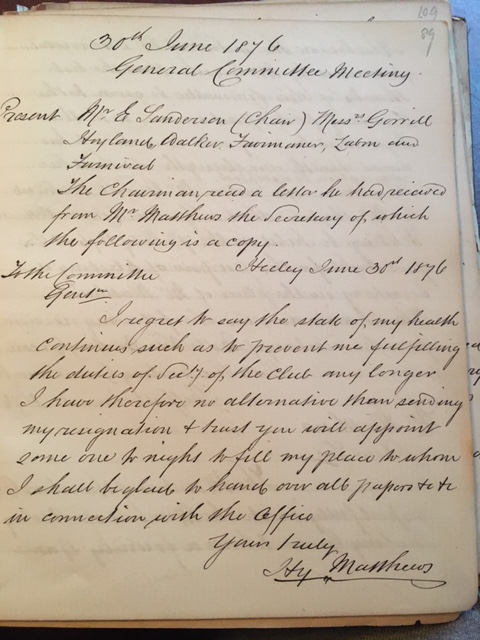
It seems Mr Matthews health did not improve, and he did indeed resign shortly after on the 30th of June. His fellow committee members recorded their thanks and best wishes, and we can see a copy of his resignation letter below. There, sadly early in the story of MBC we say goodbye to him. However, we say thank you Henry Matthews! Without your architectural plans we would not have the iconic building we all know so well today.
On to happier events! Social life at the club began each year with a dinner marking the closing of the green and ended with another dinner marking the opening of the green. Between these events there was a dance at least every fortnight, either a “soiree dansante” or a “quadrille assembly”, as well as concerts and readings. The high point of the social year was the annual dinner and ball. There was usually a charge for attendance at these functions: one shilling for the dances, but for the ball the charge was much greater. A member’s single ticket cost 6 shillings, a double ticket 10 shillings and sixpence, a “strangers” double ticket 12 shillings and sixpence. The cost of engaging 5 musicians for the evening’s entertainment was £5, 17 shillings and sixpence.
Another regular social occasion was the “juvenile party” held in January each year. The steward was empowered to buy apples, oranges, figs, bon bons and gingerbread. For these children’s parties in the early years of the club’s existence a charge of sixpence a head was made, and toys were distributed to the children, but this was soon dropped.
No reason was given in the minutes, but it is easy to imagine what kind of problems would be involved. After this there was no charge for the party. A Magic Lantern, an early type of moving picture projector, was provided at the party in 1881, and in 1883 the committee awarded the steward and stewardess 20 shillings for “the extra trouble in having made all the eatables for the children’s party”. This is the last mention of the “juvenile party” in the existing minutes books, there were no children’s parties in 1884 and 1885.
In the September of 1877, the committee resolved to purchase a piano at a cost the £42, a £12.00 down payment with the remainder to be “paid as may be arranged” with interest at 5% on the balance. We can only imagine that the music provided for the fortnightly dances and many concerts before the piano was acquired were at the same £5.17.6d cost for the musicians, so perhaps a piano was brought in for the purpose of saving cost. Perhaps the shrewd Mr Sanderson had brokered this deal too!
We know that in those days they thought nothing of moving pianos from venue to venue. Shortly after the club bought the piano, the Heeley Cricket Club of Meersbrook Lodge borrowed the piano for a concert in Thirlwell Road School and they guaranteed to “remove and return it without damage”.
The MBC Sporting Life
Although the club was founded as a Bowling Club there is very little mention of the game in any of the minute books. We know that the opening and closing of the bowling season were celebrated with a club dinner and most years the club also held a bowling tournament for which the committee or the club President provided the prize, usually a set of bowls. In 1881 the tournament was not played due to lack of interest, and the prize money was set aside for the purpose of running a billiards tournament instead! In the minutes there is only one mention of a game with a visiting team, a friendly with the Belle Vue Bowling Green, on Queens Road, which was to be held on the 26th of July 1876. Mr W.E Gillott, Secretary of Belle Vue wrote to:
“Respectfully invite the members of the ‘Heeley Bowling Green’ to have a friendly game” on “any Wednesday afternoon that will be most convenient to you”.
Mr Fairmaner wrote back to Mr Gillott on behalf of the club to accept this proposal and stated this friendly should take place on “Wednesday the 26th July at 4 o’clock” and requested “should the day and time appointed be inconvenient an early intimation will oblige.” Apparently “nine or twelve members propose attending.” Now this date was indeed inconvenient to the Belle Vue bowlers who seemed to be a well travelled lot! Mr Gillott wrote back to say:
“The date you have kindly named to pay us a visit has happened rather awkward as we play a game at Manchester on the Saturday & many of our members are going away, and so if you will postpone the visit a week or two it will suit our members better and hope it will not inconvenience yours, and I think the game can be arranged more satisfactory.”
There is no further mention of the game, so we have no way of knowing if it went ahead or any results. We can wonder if members of the ‘Heeley Green’ felt their noses were put out of joint! Maybe if it did take place, the match was not so friendly after all!
We can deduct from the previous reallocation of bowls tournament prize money; that the popularity of billiards was not in doubt. The minutes confirm this assumption as they are full of references to billiards tournaments, prize monies, entrance fees, and handicapping committees. The bylaws of billiards and the tariff were printed and hung in the saloon in 1876 and the following notice had cause to be hung in the saloon in February 1879:
“On Saturday night each game of 50 at billiards shall not occupy more than 30 minutes and each game of 75 (four players) not more than 45 minutes and the member who was scored the smallest number shall pay for the game”.
During the 10 years covered by the first minute books, two new sets of billiard balls were purchased, the cushions were repaired, the lamp shades renewed and both tablecloths were recovered. One unfortunate member, Mr Thornhill (Shock horror! Not even a full member but a lowly nominee member!) tore the cloth on one of the tables! The committee had the cloth replaced at a cost of £6 10 shillings and asked Mr Thornhill to contribute 30 shillings towards the cost. Mr Thornhill apparently refused and the affair rumbled on through the minutes until eight months later the Secretary, Mr Fairmainer, reported that Mr Thornhill had not replied to his letters demanding 30 shillings, and it was resolved that the Secretary write again giving him 7 days’ notice, and then to take the matter to the County court!
We can only assume that faced with this ultimatum Mr Thornhill paid his dues and demands as there is no mention of the matter again! Maybe this had something to do with Mr Fairmaner working in said establishment!
Along with billiards, members were also fond of a game of cards. During most winter seasons there were regular whist tournaments, and the whist tables, still in use in the games room to this day, were recovered in September 1879. The committee had purchased three dozen packs of cards in the previous month and from time to time the committee announced charges for playing cards. For example, on the 30th of November 1877 it would cost you a half penny for a game of cribbage. On the 28th of January 1881, “1 penny per half hour” was charged for any game of cards. There is an interesting entry in the minutes for the 25th of November 1876 at which the committee resolved that members should not be allowed to play at the game of Napoleon!
Although not popular now this game was certainly popular in the in the 1800’s. The old game of Napoleon consists simply of five cards dealt singly with the various players bidding in their turn how many tricks they think they can make, Napoleon is a straight forward trick taking game in which players receive 5 cards each. Needless to say, but it doesn’t seem particularly controversial enough to be banned, however it is usually played for stakes with an equal number of chips or money distributed to every player, one variant was known as ‘penny nap’ where each trick was worth 1 penny. Maybe the committee were worried this game promoted illicit gambling habits!
As many people know Angling has also certainly played a part of the clubs’ history over the years and we have some very keen and talented anglers amongst the membership currently. There was some early days interest in this sport too. There was a resolution passed in the minutes from January 1879 that permission be given to form an angling club though for some unexplained reason this section did not come to fruition at that time. Maybe in future minute books we can find out when it made its resurgence.
Goodbye Mr Sanderson, Hello Mr Sanderson!
It would seem, that our Mr Edmund Sanderson was not shrewd enough to beat the one thing that beats us all, Old Father Time. He was present at the November 1878 committee meeting and had become a member of a sub-committee created to organise another billiards tournament, but in the minutes of the December meeting we find the following:
Present, Messrs Hoyland, Walker, Cliff, Hall, Fell, Dorecourt, Linley, Labon and Fairmaner.
Resolved on the motion of Mr Hall seconded by Mr Dorecourt that in consequence of the death of Mr Sanderson, Mr Hoyland is President for the remaining year.
Resolved on the motion of Mr Hoyland seconded by Mr Linley that the following resolution be forwarded by the Secretary to Mrs Sanderson.
“That the committee learn with deep regret the loss not only they, but the members of the club have sustained in the lamentable death of the late President Mr E.H. Sanderson, who from the foundation of the Meersbrook Bowling Club was a member of the committee and an ardent and indefatigable worker in the interests of the institution.”
The committee also resolved to approach a Mr Richard Smith to arrange a portrait of Mr Sanderson as he was held in such high regard. Unfortunately, we do not have possession of this portrait today.
We salute and thank you Edmund Sanderson, without you we would not have the enviable location or building of the Bowling Club or the room for both snooker tables.
The Sanderson family influence does not end there, however. His family also had a major involvement in these early years of the club’s history, and we can assume they had also taken control of the family accountancy firm. Another Edmund H Sanderson, presumably the eldest son joined the committee at the AGM in 1879, the year following his Fathers passing. Edmund H Junior also went on to become Chairmen and President, following in his Father’s footsteps. Also, during 1881 an A Sanderson also appears in the list of committee meeting attendees, although in what capacity he served it did not say and by 1883 there is no further mention of the name.
To Roll or not to Roll? That is the question!
The two most frequent topics for discussion at the meetings of the committee were the Steward and the members subscriptions. References to the Steward were mostly instructions such as: Rolling the green; providing bills of fare for the many dinners and social occasions; and policing that no non-members use the club or club facilities. We have seen previously that we occasionally glimpse the human faces behind the minutes. For example, in a special committee meeting on the 7th of April 1879 which was held for the purpose of inquiring into the conduct of the steward in not rolling the green. The steward was called into the room and was deemed to “not having satisfactorily explained his neglect” it was unanimously resolved by the committee that he be given “one months notice to leave their service for disobedience in not carrying out their instructions!”
Eight days later another special committee meeting was held for the purpose of considering the advisability or otherwise of rescinding the resolution passed on the 7th of April, the secretary read the following letter:
To the Secretary and Committee of Heeley, Meersbrook Bowling Club.
Gentlemen,
I take the great liberty asking you to kindly reconsider your decision in reference to the notice to quit given to me by you. I beg to assure you that I was under a total misapprehension in reference to your orders as to the rolling of the green on last Saturday. I rolled the green on Monday and beg to suggest that my being married on Thursday might possibly cause me to misunderstand your orders. I may also say that I should be very foolish to wilfully risk a situation when only just entering into the great responsibility of being married. If you would give me another opportunity by allowing me to continue as your steward I promise you shall have no occasion to complain in the future either in reference to the green or any other cause.
I remain, Your obedient servant,
Charles Boler
Having read Mr Boler’s letter, invited him into the room once more and interrogated him further, the minutes state. “After considerable discussion it was unanimously resolved that the resolution passed on the 7th April 1879 be rescinded and the Steward be reinstated.”
The first interesting point to note here is that in the original minutes when Mr Boler was offered the job of steward in 1874 the minutes said that “Mr Boler and his wife” be offered the post. This begs the question, what happened to Mr Boler’s first wife? He stated in his letter above that he had got married recently, there is no mention of the first name of the first or second Mrs Boler, so we can’t be sure if this was just a typing error or if he had indeed got married for a second time.
Secondly, there seemed to be an interest at this time in levelling the bowling green. Modern greenkeepers and bowlers alike will testify in current times the use of rollers is rarely if ever utilised, yet here we are having an employee nearly losing his livelihood for not carrying this out.
This also comes on the back of other work to alter the green around this time, the meeting minutes from 25th October 1878 list the resolution of a motion to award “the sum of three pounds to Mr E.H Sanderson for the purpose of levelling and relaying certain portions of the Bowling Green in accordance with his proposal.”
As a bowler myself who has spent time working on the green, I can only now wonder what interesting and tricky playing features were levelled out and potentially lost at that time.
All those many management decisions along with bowling, billiards, card playing and socialising activities obviously necessitated the need to enjoy a nice cigar afterwards! At the same meeting the motion was carried to order the following from Duncan Gilmour, a local wine and spirit merchant in Sheffield:
12 boxes of cigars at 2” & 3 boxes at 3”
The club was also purchasing wine and spirits from Gilmour’s during this time, but unlikely beer, as officially they didn’t start brewing until 1884 at their Furnival Brewery. Gilmour’s more famously moved to the famous Lady’s Bridge Brewery near the Wicker in 1900 and brewed there and their Merseyside brewery until being bought out by Joshua Tetley’s in 1954. More recently people will remember Whitbread’s took over operations at Lady’s Bridge until its closure in the 1990’s.
Mr Boler redeemed!
It seems that Mr Boler’s promise to give the committee no occasion to complain in the future was to be fulfilled. At the same AGM that E.H Sanderson Jnr joined the committee there is also listed one Mr Charles Boler as a new member of the Committee!
What is unclear from the minutes is how long Mr Boler continued in his role as Steward, but it appears he certainly did immediately after his rolling indiscretion. It seemed in the following weeks as though things had settled down a bit, with business as usual returning to organising opening dinners and trying to ensure these went smoothly. Another World-famous Sheffield company, Messr’s Mappin & Webb, the Cutlers, were contacted to purchase “4 dozen table knives and 2 dozen dessert knives”. These would be worth a pretty penny today I would bet!
During April 1879 as Mr Boler carried on as Steward, it seems he was not completely off the hook. Minutes from a general committee meeting on the 24th of April 1879 stated that, “the Steward be asked to send a detailed account of quantities of earthenware supplied to the club up to the present date as the committee consider the annual charges to be excessive!” It was also resolved that Mr Labon and Mr Dorecourt take an account of the stock in the cellar and on the Steward’s hands, so the committee were certainly taking a keen interest in club operations at that time. The AGM that Mr Boler and E.H Sanderson joined the Committee was held on the 14th May 1879 and after this we start to see Mr Boler’s name on meeting minutes.
Two months later the committee, including Mr Boler, considered a report from the Steward on the behaviour on Messrs George Wragg, Thomas Cadman, and Jonathan W Bell who stayed in the saloon until 12:35 am on the 9th June, and insulted the Steward when he attempted to carry out his duties. If only the walls could tell us the nature of this scandalous behaviour!
It would seem strange that Mr Boler is named as a committee member but not named as Steward. If he were reporting on such misdemeanours as part of his Steward’s role, it could be because of his newfound responsibilities as committee man, and the watchful eye of his peers that he was perhaps being ultra-attentive. At the next committee meeting it was resolved to hang a notice in the saloon respectfully informing members that no refreshments will be provided after 11:45 pm and all games must be finished by midnight and that the Steward may “turn down the gas preparatory to closing the club” as near to that time as possible.
Another founding Father of MBC leaves the story at this point. In the September 1879 meeting it is reported that Mr Joseph Sales Labon was to resign his position as Honorary Secretary as he was off to reside in sunny Bridlington! The resolution was unanimously passed that the best thanks of the Committee be given to him for past services and wish him every future success, Mr Fairmainer was to take on the role of Secretary.
Please Sir, can I have some Mower?
This section may be of particular interest to not only bowlers but professional and amateur greenkeepers amongst our members and visitors.
As well as indiscretions with the rolling of the bowling green there are several references throughout the minutes to issues with the ‘grass cutting machine’. Generally, they reference it needing some sort of repair and MBC seemed to be keen to keep up to date with the relatively new technology of the gear or chain driven lawn mowing machine.
The lawn mower had been invented in 1830 by Edwin Beard Budding, an Engineer from Stroud in Gloustershire, after seeing cloth cutting machines in cloth mills. By the 1850’s, Budding’s early patents had lapsed, and other companies were able to introduce their own machines. Around this period, Thomas Green and Son of Leeds introduced a mower called the ‘Silens Messor’, meaning silent cutter. It seems that MBC had a Thomas Green machine as the minutes of 4th April 1879 state:
“Resolved on the motion of Mr Cliff, seconded by Mr Linley, that the lawn mower be sent to Mr Thomas Green & Son, Leeds for repairs.
Thomas Green & Son – ‘Silens Messor’ circa 1860.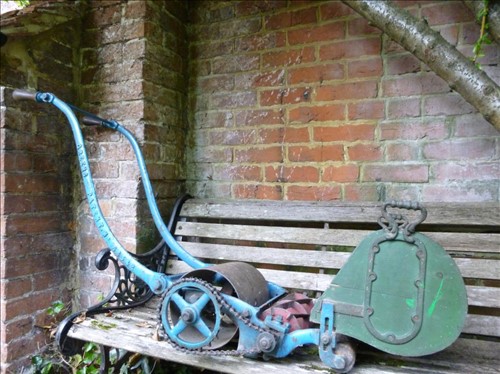
Whether these repairs did not take place or were not successful is not clear, but by the meeting on 28th May 1880 we find the following:
“Resolved on the motion of Mr Sanderson, seconded by Mr Boler that an Archimedean Machine be purchased from Mr Linley at the price of £5 & 10 shillings, for cutting the grass of the Green.”
Mr Cliff and Mr Hand suggested that “the old grass cutting machine be sold for the best price that can be got for it”.
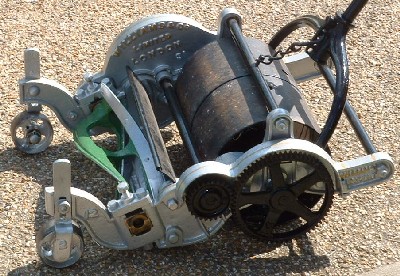
The Archimedean Machine is an intriguing sounding name, but it was not just a fanciful name assigned by a Victorian MBC Committee member, it was the latest technology in mowers. The Archimedean lawn mower was designed in 1869 by Amariah Millar Hills, an American who had a factory in Connecticut. He was the first American to be granted a patent for a lawn mower, in 1868. The name of the mower comes from the shape of the cutting cylinder, which is like an Archimedean screw in being spiral or helical in profile. The mower was innovative through its compact and lightweight design compared with mowers from other manufacturers, and had a solid cast cutting cylinder with just two blades.
The mower was later manufactured for the UK market by Williams and Company of London as sole Agent for Hills, so it is possible Mr. Linley had a Williams machine for sale at the time.
As can be seen from the photographs of the likely models that were used at the Bowling Club, the design of the lawn mower then, is very recognisable today. As someone who has had opportunity to cut a bowling green with modern motorised green cutting machines, I can honestly say I think it would be a fair task cutting one with a push along model even if it was gear or chain driven!
A Williams & Co. Archimedean Mowing Machine
To pay or not to pay? That is another question!
Subscriptions and share subscriptions are a constant regular topic of discussion at this time, usually to get members to pay their dues and demands, which as previously explained included a share subscription. Proposals were made by the Secretary Mr Fairmaner in 1880, to rescind decisions made the previous year where share subscriptions had been reduced from twenty one shillings to 15 shillings, and annual membership had been reduced from thirty shillings down to twenty four shillings. Presumably, the reduction was to encourage payment, but the resolution to rescind these previous decisions was passed unanimously.
The complexity of membership as seen above, along with difficulty collecting subscriptions took an incredible amount of Committee time, especially the latter, as we shall discover below:
30th November 1877
“The Secretary caused notice in writing addressed to Thomas J Revill of the White Lion, London Road, Heeley. To be sent through the post informing Mr Revill of his neglect in paying his subscriptions due in May.” Mr Revill it seems did not respond and after 28 days the committee moved to resolve that his share “be deemed forfeit and his named erased from the Books of the Club.”
28th November 1879
“Resolved on the motion of Mr Dorecourt, seconded by Mr Hall that the Secretary write to Messrs Thomas Credland, Bramhall, Matthewman, Gillott and the Trustee of Ian Wilkinson that unless their subscription be paid the shares to be forfeited in accordance with article 34
It seems that these letters had the desired effect at least some of the time, although it seems they were not always written and posted immediately either as we see below that Mr Bramhall and Mr Matthewman were still being chased:
7th April 1880
“The Secretary having reported that on the 30th day of January 1880 he caused notices in writing addressed to Mr Henry Matthewman of Alexandra Road Heeley, and John Bramhall of Sheaf Street Heeley, to be sent through the post informing them of their neglect to pay their subscriptions due in May last, and more than twenty eight days having elapsed since such notices were sent. Mr Matthewman and Mr Bramhall having failed to comply with such notices.” Therefore, their shares were also deemed forfeit and their names removed from the record books.
2nd March 1881
“The Secretary having reported that on the 31th day of October 1880 he caused notices in writing addressed to Mr Henry Booker of Albert Road Heeley, and Reuben Clarke of The Wicker Sheffield, to be sent through the post informing them of their neglect to pay their subscriptions due in May last, and more than twenty eight days having elapsed since such notices were sent.” Again, Mr Booker and Mr Clarke had their shares deemed forfeit and their names removed from the record books of the Club.
It seems some already mentioned were repeat offenders, more specifically Messrs Credland and Gillott!
28th April 1882
The Secretary had sent the usual notices to: Mr Thomas Credland, Heeley Bridge Heeley; Mr George Dawson, Chipping House Road; Mr John Milner, Trafalgar Street Sheffield; Mr Arthur Gillott, Ecclesall Road Sheffield; Mr Herbert Hodkin, Bramhall Lane Sheffield.
Needless to say, Messrs Credland and Gillott must have decided not to pay this time and all the above mentioned had their names removed from the Books and their shares forfeited. This must have seemed a significant fall from grace for Thomas Credland, who we discovered earlier was one of the founding members of the Club’s first committee. With the local area business world connections of the committee members, one wonders if this non-payment could have been damaging for the reputation of the Timber merchant and chimney piece manufacturer from the Heeley Bridge Works
The sharp eyed amongst you might think you have seen a typing error above, however Bramall Lane in those days was still known as Bramhall Lane, named after the Bramhall family, well known file manufacturers, who built the White House on Whitehouse Lane which was to become Bramall Lane. The White House is still there, but now more well known as the Sheaf House public house. It seems the more familiar spelling of Bramall Lane became widely accepted in the late 1880’s.
A Poacher turned Gamekeeper ensnares the Poachers!
By 1882 it seems that issues regarding the Steward had made a return although from the minutes it becomes apparent that it was not Charles Boler, who had been a committee member for the best part of three years by this time. This was to become a particularly turbulent time for the young club, as we shall discover.
The watchful eyes of the Committee men seemed to be firmly on the mystery Steward whose identity we do not know. At a Special Committee Meeting on 27th May 1882 Mr Boler moved that Mr Kaye be made Store Keeper for the ensuing year, this was resolved after being proposed and seconded by no less than esteemed Messrs Edmund H Sanderson and Charles Hoyland! Also resolved at the time a motion by Mr Fairmainer stating: “the stock kept by the Steward in future be £10, and the Steward give to the Secretary a receipt for this amount and at the end of each month if required, his stock shall be taken by the Secretary, and he shall account to him for his stock & cash in hand to this amount.”
It seems the traps were baited, and they were out to catch the Steward. Three meetings later at a general meeting of September 1st, 1882 where it is recorded in the minutes:
“The Secretary having reported that he had that day taken stock of the goods held by the Steward and found it much less than on June 30th. It was decided to have the Steward in the room to ask him for an explanation. He said that he would resign his appointment and pay off all deficiency of his stock and also his account book.”
Mr Boler and Mr Kaye then moved that the Secretary advertise for a Steward and Stewardess and they would review any applications at a follow up meeting a week later. On the 15th September the Committee had reviewed suitable applicants and offered the position of Steward & Stewardess to a Mr & Mrs Whadcock, with the Secretary making a point in the appointment letter, “stating the conditions on which they had been appointed”. It is not known under what conditions Mr & Mrs Whadcock had been appointed, but we can only assume that the Committee had made them strict and possibly a little too restrictive. It was to be a very short-lived appointment, just over one month later, on 27th October, we find that the Secretary reported that “the Steward, William Whadcock had resigned his appointment”.
This left the Committee in a real predicament, with the Secretary asked to contact Messrs Cubley, Cookman & Goodlad, all previous applicants, to invite them to an appointment with E.H. Sanderson, Mr Hand and Mr Boler, to meet them to discuss the Stewards position. All the previous applicants declined the invitation. The Bowling club advertised the position again with several applications received “at the green” and “were seen by several members of the Committee who selected a few to be enquired about by Mr E.H. Sanderson and Mr Fairmaner who were to report to the monthly committee meeting. It seems that the ‘big guns’ had been rolled out to vet the new applicants.
Short Lived Affairs!
By the next meeting in November the decision was made after a proposal by Mr Boler that “the Steward be paid 22 shillings per week and that the profits on all non-excisable articles be reserved (namely all mineral waters) by the Committee.” The muddied waters become a little clearer. We know Mr Boler when he was Steward was paid 20 shillings per week but allowed to keep profits on non-excisable goods, so we hardly need to employ the services of a certain Mr Sherlock Holmes and Dr John Watson to work out what had been happening in recent times! A motion was carried that the successful applicants would be a Mr & Mrs Wilkinson who would be paid 22 shillings per week. Recalling the earlier entry of the committee awarding the steward and stewardess 20 shillings for “the extra trouble in having made all the eatables for the children’s party”, it was the Wilkinson’s that received this payment for what would be the last “juvenile party”. This was decided on January 26th, 1883 at the monthly general meeting, but very shortly after, a special meeting held on February 10th minutes the following:
“It was resolved on the motion of Mr Hoyland, seconded by Mr Hall that the Steward be at once discharged.
Resolved on the motion of Mr Boler, seconded by Mr Benton that a Policeman be engaged to stop in the Saloon on Saturday & Sunday nights”.
What on Earth was going on? Was there an actual Policeman on the premises? Or were they more like a Victorian version of a modern-day door security person?
Messrs Sanderson, Fairmainer & Kaye formed a subcommittee to select another Steward to be put forward for appointment by the committee, time was off the essence, the Club was going through Stewards faster than they were cigars and good Irish whiskey!
Only two days later at another Special Meeting we find that a Mr & Mrs Joseph Kelly were engaged as the new Steward & Stewardess, and it was hoped “that they devote the whole of their time to their duties of the office, the salary to be 22/- per week and the engagement to be terminated by four weeks notice from either party”.
The Kelly’s were in for a baptism of fire however, and one can only assume that the ‘Club Bobby’ wasn’t in attendance on the night in question, but the Secretary once more was tasked with writing to unruly badly behaved members! Mr J.J. Gallemore & Mr F.A. Gallemore were the offenders this time, both ‘nominee members’ who were asked to give a verbal or written explanation for their poor conduct in the Saloon. With no explanation forthcoming, they were both subsequently ‘black-balled’.
That hope that Mr & Mrs Kelly were the answer to previous problems, was again to be in vain. At yet another Special Meeting held on May 25th 1883 it was carried that “one months notice be given to the Steward Mr Joseph Kelly to terminate his engagement as Steward and his wife as Stewardess,” and there they leave the story.
Safer Hands Steward the Ship
In June of 1883, Mr & Mrs Marshall became Steward & Stewardess, ending this run of insecurity and uncertainty. It would seem that this issue at least was resolved, and the last mention in the minute books regarding the Steward is from the 7th July 1884 with the resolution that he be allowed 5 shillings for waste in every 18 gallons of beer sold, an increase from 3 shillings and sixpence. It might have seemed that the stormy sea the Club had been sailing had calmed, however we shall see that the following period of the fledgling organisation might provide some contributory explanation as to how the Stewarding issues had arisen.
The Gathering Storm
The collection of subscriptions towards subscription shares and trouble with nominee memberships were taking its toll. As covered previously many members had their names struck from the records of the club, with a total of 27 members names erased between 1877 and 1884, with many more receiving warning letters. In the most extreme cases three ex-members were taken to Court. At the General meeting of 30th March 1883 no less than 18 members had received letters from the Secretary informing them of their neglect to pay their subscriptions, at the same meeting a further dozen people were named as not responding to their previous notices and so were struck from the records.
I believe that the issues with subscriptions collection had become critical for the club’s cash flow, and that then, as it is now, poor cash flow to a small business or organisation can be fatal. An indication of this can be seen in the entry for February 26th 1883, where the committee resolved that “the accounts owing by the club be paid as far as it was possible with the money in hand.” At the same meeting, the motion was passed to recover one of the billiard tables and have the balls re-turned, but the members were to be “canvassed for subscription towards the expense.” There is no mention of how this message was received in the general membership population, but one can imagine it would not have gone favourably.
By this time, the membership options had changed significantly from the original £5 share and 10 shillings & sixpence subscription, and there were 5 classes of membership. Along with the above conditions there were also subscribing members, paying £1, & 5 shillings, and non-proprietary members who paid 15 shillings per annum. On top of this, there were also annual members and nominee members, so it becomes apparent why so many issues with cash and potential Stewarding issues. It would have been a nightmare trying to differentiate between members and shareholders and collect fees all owing at different times of the year!
In what would seem an attempt to try and recoup some cash, the committee resolved at the April special meeting that Temporary Members be allowed “for any period of less than one year on such terms” as the committee “may deem advisable.” This would mean a rule 13 amendment at the upcoming AGM.
On the day of the AGM, 23rd May 1883 a Bowling match of some sort was to be held at 4pm, with a ‘meat tea’ to be provided for 1 shilling & sixpence per person at 7pm before the meeting at 8pm. Perhaps these were proposed to sweeten the deal of the rule change and lift the mood of the shareholders! Another new directive appeared to be the reissuing of shares forfeited by ex-members with a proposal that a “Mr R Clarke be admitted a member in place of Mr C Padley whose share has been forfeited” upon a payment of one Guinea by Mr Clarke. At the AGM it was resolved that the rule 13 amendment go ahead, so that “the Committee may from time to time, if they shall deem it expedient to do so, resolve to admit any number of persons, not exceeding 50 per year, as temporary members. – Without requiring such person to hold a share or shares in the capital of the association.”
After the above period of constant activity, and the appointment of the Marshall’s as Steward & Stewardess in June 1883, the minutes for the remainder of 1883’s meetings seem fairly quiet. The Committee were attempting to carry on as normal, arranging the usual busy schedule of dances and entertainment, along with whist & billiards tournaments and even a picnic outing for the members! It appears at this stage on paper at least, as though the worse was behind them, with new members being admitted, and a full social calendar to help bolster the coffers. With the annual New Year Ball to look forward to on January 3rd, we could be forgiven to think that MBC was entering 1884 on a wave of optimism. Indeed, the main topic of discussion at the January meeting was the arrangement of dances through the early part of the year to be held in January, two in February, two in March and one in April. The band for the dances was to be engaged by the newly formed ‘Recreation Sub-committee’ for the coming year “and that the cost does not exceed last year.”
By February however another sub-committee featuring Messrs Fairmainer, Cliff, Kay & Hand, be formed to “report on the financial position of the Club”. March 1884 had two meetings. At the first ‘Special’ meeting the Committee resolved that, “Counsels opinion be taken on the several questions as to the liability of Shareholders and their transferences to pay the mortgage or other debts upon or against the club”. The Clubs Solicitors, Messrs Smith, Smith & Elliott were instructed to prepare a case.
Although Counsel’s opinion is not quoted in the minutes, it appears from the minutes of 31st March, 1884 that his advice was to take legal action, as a motion was passed calling a meeting of all Shareholders to discuss “authorising actions, suits or other proceedings to be taken against any shareholder not having paid his subscription in the name of the Secretary,” and then the following bombshell, “and of considering the desirability of winding up the Association.”
At the Shareholders meeting held on 21st April 1884 the authorisation was given to proceed as recommended by the Club Solicitor. We then find “that in the opinion of the meeting it is expedient that the dissolution of the association take place,” and that, “on being put to the meeting it was carried unanimously”.
This motion needed ratification, and it seems some confusion arose with trying to ratify it at the AGM that 30th of May, as the meeting was made ‘Special’ to confirm or otherwise, the resolution passed at the April meeting. It was then agreed that this ‘Special’ part of the meeting be adjourned until the 27th of June. Confusingly this adjournment then resolved that this meeting be further adjourned sine die.
July 1884 saw the Association instruct the Secretary and Solicitor to bring County Court proceedings at once against, Henry Stratford, John Barton, Charles Clegg & Henry Swinscoe. By the 30th October proceedings were also being persued against Henry Howe, John D Harrison, Charles Garland and George Kay. This was to be the last committee meeting entry before The Meersbrook Bowling Club Limited was registered at Companies House on the 11th November 1884. There is absolutely no mention of this registration in the minute book and indeed no entry for November at all!
After an abandoned dummy run on the 22nd, the proposition “That the Dissolution of the Association is expedient” was finally formally put to a meeting held in the club saloon on “Tuesday the 30th day of December”, and was passed unanimously. The committee was then authorised to “sell all the personal and movable property of the Association, to The Meersbrook Bowling Club Limited for the sum of £150”. The Committee were also “hereby authorised to give up the possession of the Club premises to Mr Charles Hoyland, who appears to have been the Mortgagee for the new Company. And in a final parting shot to how things had been run by the Association and how things were going to be, that the Committee pay a further £150 “and any other monies in their hands” for discharging the debts and liabilities of the Association and subsequent expenses. That they should then raise a pro rata levy from members of the Association and that legal proceedings were to be brought against any member not willing to pay such levy.
The final minute entry lists that the following subscriptions: Charles Walker 21/, Samuel Gill 21/, Charles Boler 21/, J Tomlinson 21/ and E.H. Sanderson 2/2/, all be written off as unrecoverable. And that the following accounts be paid: Gas Co., Water Co., Wheatley & Son, Marples & Co., A. Sanderson, Rawson & Co., Gillot, Addy, Swallow, Parker, Wragg, Smith & Elliott, Hoyland, Law.
And with that ‘business as usual’ entry, this summary of the first ten years of the history of Meersbrook Bowling Club comes to an end. It was the closing of the tumultuous foundation years of the Association, and the birth of the new era for a registered Limited Company that is still trading to this day.
This summary was compiled during 2020 in the Clubs 146th year, when the world was in the grip of a global corona virus pandemic that brought numerous challenges all around the world, to everyone at MBC and the Meersbrook, Heeley and wider Sheffield Community as a whole. At the time of writing the second wave of the virus is having further impact on our day to day lives, and how we interact in our working, social and sporting lives. With Christmas and the New Year on the horizon, our hopes and wishes are for a safe, healthy, and prosperous 2021 and beyond!
Ian Christopherson
Director of The Meersbrook Bowling Club Limited
19th October 2020
 Meersbrook Bowling Club Limited
Great read Ian,
I appreciate all the effort that has gone into the research of this interesting article.
John Batty.
LikeLike
Hi John
Thanks very much! We were lucky to find the original minute books, they were under one of the bench seats. Need to try and track down some more. Would be great to cover the WWI WWII years. If you have any idea where more of the early minute books may be, any help would be much appreciated.
Best Regards
Ian
PS: part 3 of first ten years coming soon!
LikeLike
Our family lived in the old Vernon House, 275 Albert Road, until 2005. My father, Eric Ashton, was the MBC treasurer in the late 70s. I have always wondered why 275 Albert Road had a door lintel with “Vernon House” written on it. Thanks to this page mentioning the founding members of the Club you mention “Mr Thomas Vernon, a Cork manufacturer with premises at 2 Union St, home address 119 Kent Rd now 275 Albert Rd.”. Live and learn, and what a coincidence because our family were Club regulars from the 60s to the early 00s. Great memories.
LikeLike
Hi Jim
Thanks very much for this insight into the history of MBC! It’s great that your family had some long standing links to our story, and also a unique one to one of our founding fathers. Much appreciated that you’ve shared this. Hope you can pop back some time to relive some of those memories. You’d be very welcome.
Best Regards
Ian
LikeLike